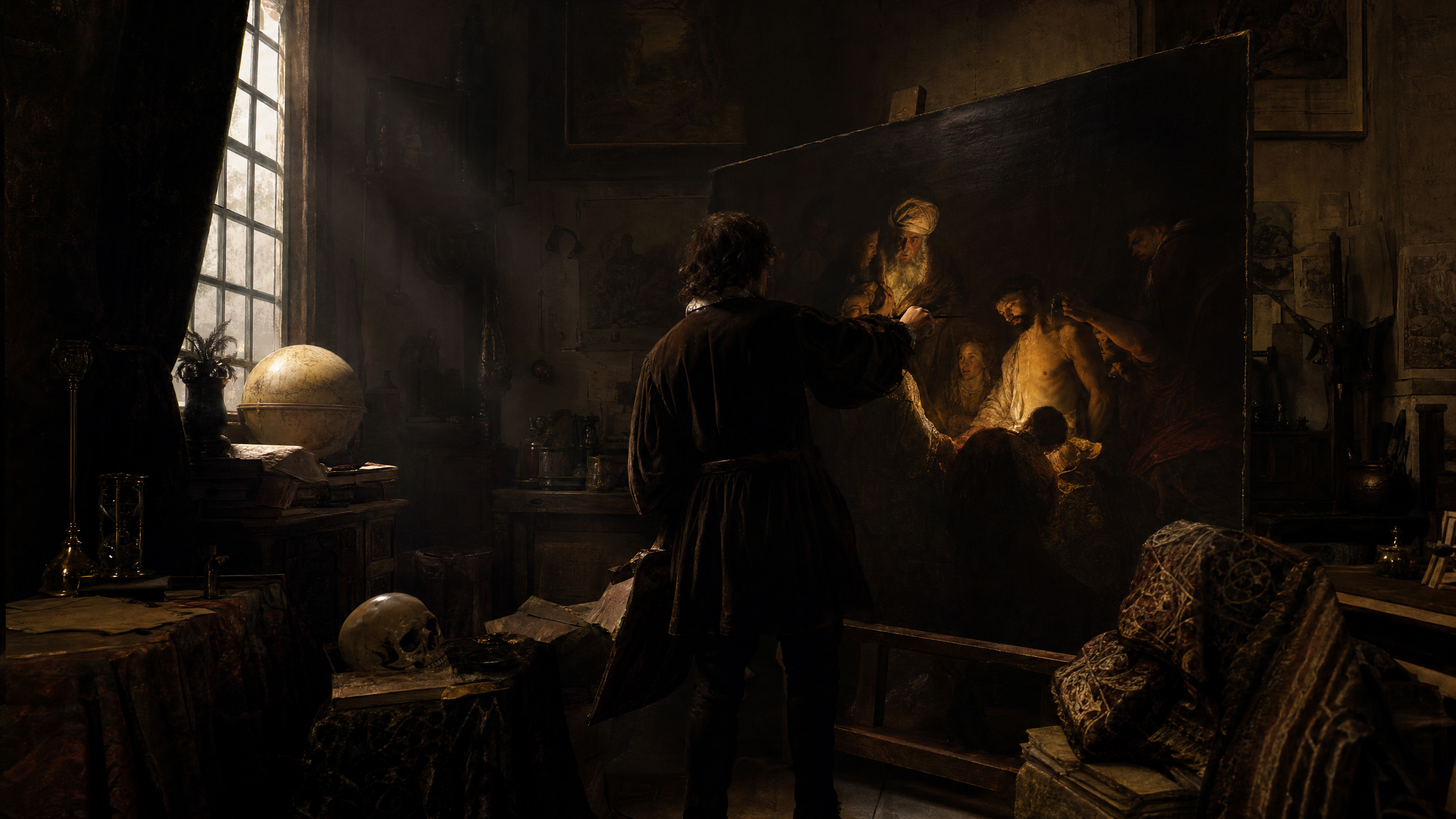
The Divine Rapture: Bernini's Ecstasy of Saint Teresa and the Power of Faith
Experience the overwhelming spiritual passion captured in marble, a masterpiece designed to stir the souls of believers during a time of religious fervor.
Historical Context
The Counter-Reformation
The Story
Gian Lorenzo Bernini's 'Ecstasy of Saint Teresa,' sculpted between 1647 and 1652, is a breathtaking embodiment of the Counter-Reformation's artistic ideals. Commissioned for the Cornaro Chapel in Santa Maria della Vittoria, Rome, this sculptural group depicts Saint Teresa of Ávila's mystical vision, where an angel repeatedly pierces her heart with a golden spear, causing both immense pain and spiritual ecstasy. The Catholic Church, in its efforts to win back adherents from Protestantism, sought to create art that would evoke profound emotional responses and reinforce the tangible reality of spiritual experience. Bernini masterfully combines sculpture, architecture, and hidden light sources to create a theatrical, immersive experience. The swirling drapery, the saint's expression of divine rapture, and the dynamic composition were all designed to transport the viewer, making the spiritual palpable and inspiring fervent devotion, thereby serving as a powerful testament to the Counter-Reformation's message.
Deep Dive Essay
The full historical picture
The Divine Rapture: Bernini's Ecstasy of Saint Teresa and the Power of Faith
The World at the Time
Imagine Rome in the mid-17th century. The air crackled with religious fervor and political intrigue. This was the heart of the Counter-Reformation, a powerful, sweeping movement by the Catholic Church to reclaim its authority and followers after the seismic shock of the Protestant Reformation. For decades, Europe had been torn by religious wars, and the Church understood that winning hearts and minds required more than just theological debate. It needed to speak to the soul, to offer an experience so profound and immediate that it would leave no room for doubt. The Council of Trent, which concluded in 1563, had laid down the artistic blueprint: art must be clear, compelling, and above all, emotionally resonant, designed to inspire piety and reinforce Catholic doctrine. This was not a time for subtle allegories or intellectual puzzles; it was a demand for visceral, undeniable truth. Churches were being rebuilt and redecorated with unprecedented grandeur, transforming into theatrical stages for divine drama.
This era saw the flourishing of the Baroque style, an artistic language perfectly suited to the Church's ambitions. It was a style of movement, drama, and intense emotion, designed to overwhelm." It was a battle for the very soul of Europe, fought not just with armies and decrees, but with paint, marble, and light.
The Artist and the Work
Into this charged atmosphere stepped Gian Lorenzo Bernini, a prodigy who by 1647 was already a titan of the Roman art world. He was not merely a sculptor, but an architect, a painter, and a stage designer, a true Renaissance man born a century too late, perfectly embodying the Baroque ideal of the multi-talented artist. Bernini was deeply devout, and his personal faith fueled his artistic genius. When he received the commission from Cardinal Federico Cornaro for his family chapel in the church of Santa Maria della Vittoria, Bernini seized the opportunity to create a masterpiece that would encapsulate the very essence of Counter-Reformation spirituality. He wasn't just carving a statue; he was crafting an entire experience.
The result, sculpted between 1647 and 1652, is the breathtaking Ecstasy of Saint Teresa. Here, we witness Saint Teresa of Ávila, a 16th-century Carmelite nun and mystic, in the throes of a divine vision. Her head is thrown back, mouth agape, eyes closed in an expression of overwhelming rapture. Her drapery, rather than simply clothing her, swirls and billows around her, suggesting an inner turmoil and outward spiritual force. Hovering above her, a smiling angel, almost playful, holds a golden spear, poised to pierce her heart. Bernini understood Teresa's own writings, where she described this experience as a "sweet wounding," a pain so exquisite it was pure joy. He masterfully integrated the sculpture into its architectural setting, using hidden windows to bathe the scene in a divine, golden light, making the marble appear almost ethereal. On either side, carved in relief, members of the Cornaro family watch the scene unfold from what look like theater boxes, blurring the line between viewer and participant.
Why It Still Matters
The Ecstasy of Saint Teresa is more than just a beautiful sculpture; it is a profound statement about the power of faith and the human experience of the divine. It reveals the Counter-Reformation's brilliant strategy: to make the spiritual tangible, immediate, and utterly captivating. Bernini’s genius lay in his ability to translate an internal, mystical experience into a universally understood visual language of emotion and drama. For a modern viewer, it offers a window into a world where art was a primary vehicle for spiritual understanding and communal experience. It reminds us that art can be a powerful force, capable of stirring the deepest parts of our being, and that even centuries later, the raw emotion and theatrical brilliance of Bernini's vision continue to resonate, inviting us to contemplate the boundaries of human experience and the enduring allure of the divine.
The Work
Ecstasy of Saint Teresa
Gian Lorenzo Bernini
THE & CO. SERIES
See Also in This Era
The same historical moment, seen through different creative lenses.
Wolfgang & Co.
Classical Music
The elaborate ornamentation of Baroque fashion — wigs, brocades, lace — was the visual equivalent of Bach's counterpoint.
Explore this era →
Ernest & Co.
Literature
Molière, Racine, and Swift were writing in the same court culture that produced Baroque and Rococo fashion excess.
Explore this era →
Continue exploring
Back to Baroque & Rococo Art