1600–1750
Baroque Era
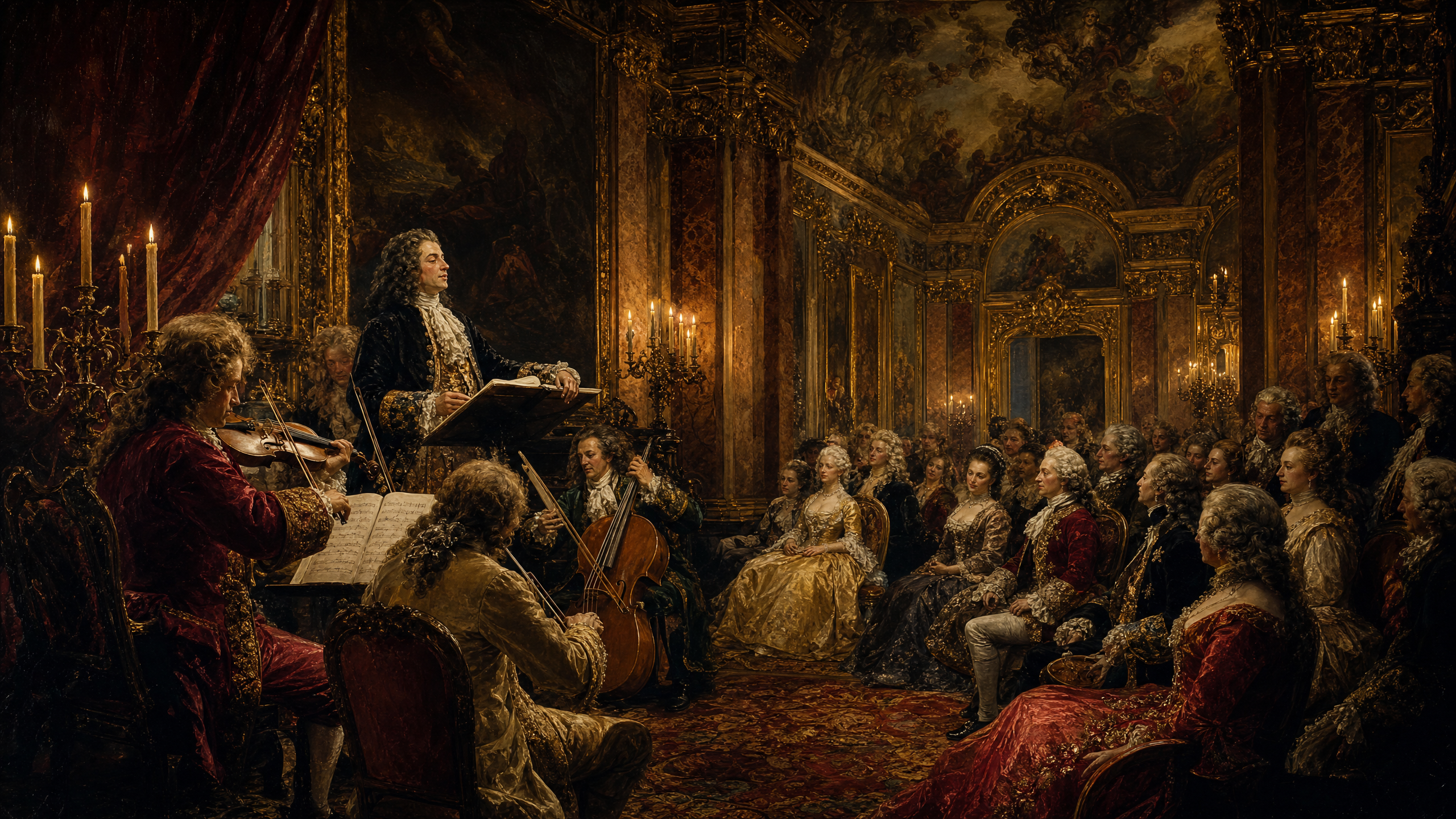
An age of ornate grandeur and profound innovation, where music mirrored the opulence of absolute courts and the fervor of faith.
Composers
4
Stories
3
Listening Journey
4 pieces
The World
Historical Context
The Baroque Era was marked by absolute monarchies, such as Louis XIV's reign in France, and significant scientific advancements, including Isaac Newton's laws of motion. Religious conflicts, like the Thirty Years' War, profoundly shaped the political landscape, while the rise of mercantilism fueled global exploration and trade. This era saw a flourishing of arts that emphasized drama, emotion, and elaborate ornamentation, reflecting the power and prestige of both church and state.
The Sound
What to Expect
Baroque music is characterized by its rich, complex textures, often featuring multiple independent melodic lines weaving together in a polyphonic tapestry. It evokes a sense of continuous motion and grandeur, with dramatic contrasts between loud and soft sections. Ornamentation adds expressive flair, while the 'basso continuo' provides a strong harmonic foundation, creating a sound that is both intellectually stimulating and deeply emotional.
The Masters
Key Composers
History through music
Stories of the Age
The Birth of Opera: Monteverdi's L'Orfeo and the Power of Myth
Imagine a time when music could tell a story so vividly, it felt like watching a play unfold before your eyes. The Baroque era saw the birth of opera, a revolutionary art form that combined drama, poetry, and music.
Claudio Monteverdi
L'Orfeo
Bach and the Art of Divine Mathematics
How does a devout Lutheran church musician in 18th-century Germany create music that feels both mathematically perfect and spiritually transcendent? The answer lies in Bach's extraordinary life and genius.
Johann Sebastian Bach
Brandenburg Concerto No. 3
Handel's Messiah: When a King Stood Up
A piece of music so powerful that a king rose to his feet in reverence, starting a tradition that endures to this day. The story of Handel's Messiah is one of faith, ambition, and unexpected triumph.
George Frideric Handel
Messiah: Hallelujah Chorus
Start here
Your Listening Journey
A curated sequence of pieces to guide you through this era, from the most accessible entry point to deeper explorations.
The Four Seasons: Spring
Antonio Vivaldi
Why start here
The most accessible entry point into the Baroque, this programmatic concerto paints vivid pictures of nature with astonishing energy.
What to listen for
Listen for how the violin imitates birdsong, the murmur of streams, and the rumble of a spring storm.
Brandenburg Concerto No. 3
Johann Sebastian Bach
Why start here
A masterclass in Baroque energy and counterpoint, with three groups of strings in constant, exhilarating dialogue.
What to listen for
Notice how the three string groups toss musical ideas between each other like a conversation.
Messiah: Hallelujah Chorus
George Frideric Handel
Why start here
One of the most powerful choral moments in all of music, and a gateway to understanding Baroque grandeur.
What to listen for
Feel the immense energy and majesty of the chorus, with its soaring melodies and dramatic build-ups.
L'Orfeo: Toccata
Claudio Monteverdi
Why start here
Step back to the very beginning of opera with this fanfare, a dramatic and ceremonial opening that announces the arrival of a new art form.
What to listen for
Notice the bold brass fanfares and the sense of anticipation, setting a majestic and theatrical tone.
THE & CO. SERIES
See Also in This Era
The same historical moment, seen through different creative lenses.
Pablo & Co.
Visual Art
Caravaggio, Rembrandt, and Rubens painted in the same dramatic chiaroscuro spirit as Bach and Handel composed.
Explore this era →
Ernest & Co.
Literature
Milton's Paradise Lost and Molière's plays were the literary voice of the same absolutist courts that commissioned Baroque music.
Explore this era →
Coco & Co.
Fashion
The elaborate wigs, brocades, and court dress of Versailles were the visual equivalent of Baroque musical ornamentation.
Explore this era →