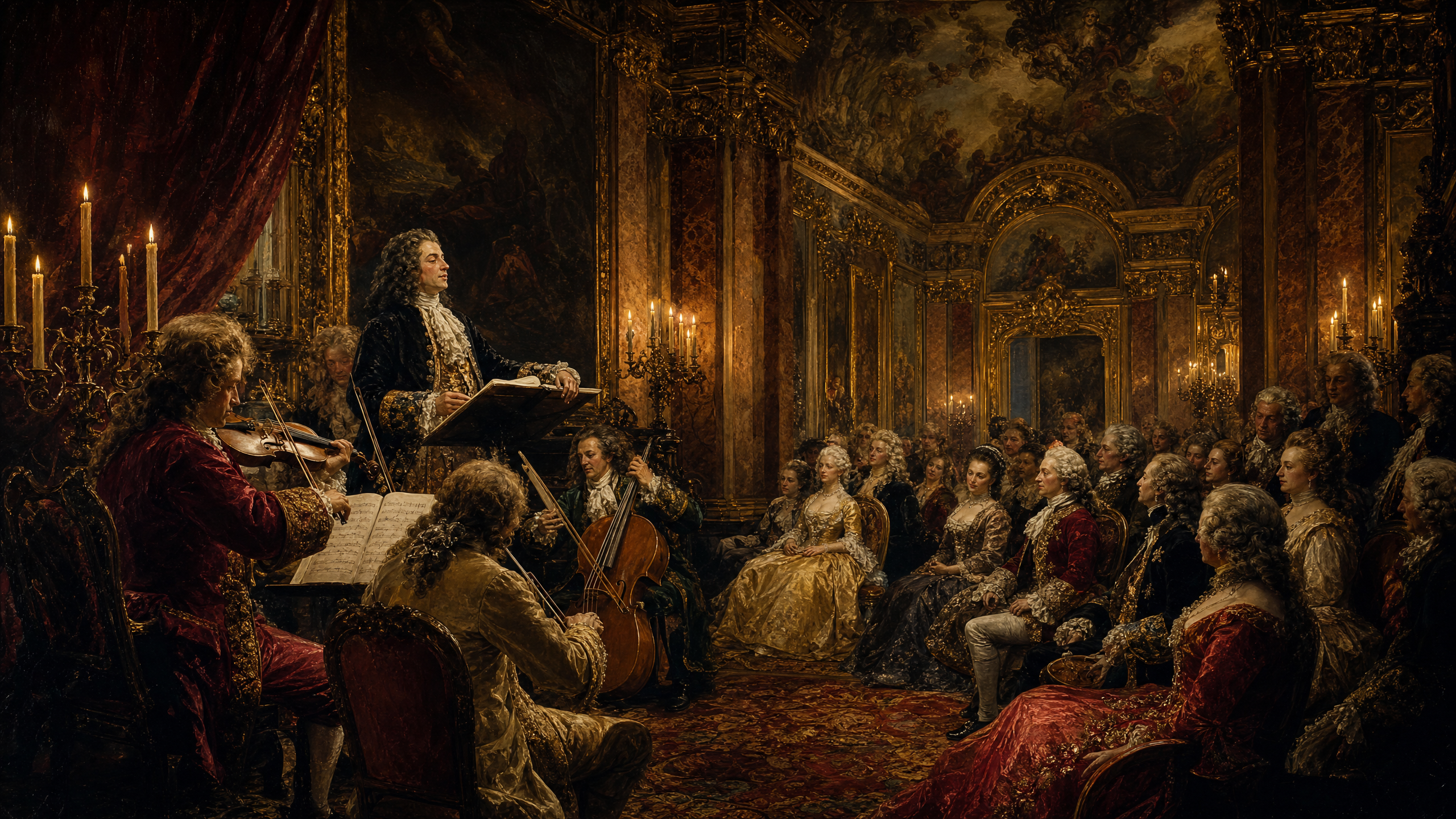
The Birth of Opera: Monteverdi's L'Orfeo and the Power of Myth
Imagine a time when music could tell a story so vividly, it felt like watching a play unfold before your eyes. The Baroque era saw the birth of opera, a revolutionary art form that combined drama, poetry, and music.
Historical Context
The Florentine Camerata's desire to revive ancient Greek drama and the intellectual ferment of early 17th-century Italy.
The Story
In 1607, Claudio Monteverdi premiered 'L'Orfeo,' often considered the first true opera. This groundbreaking work, based on the Greek myth of Orpheus, transformed music from a mere accompaniment to a central narrative force. It was a direct result of the Florentine Camerata's intellectual pursuits, who sought to recreate the emotional power of ancient Greek tragedy. Monteverdi's innovative use of dissonance, word-painting, and a large orchestra for dramatic effect set the template for centuries of operatic composition.
Deep Dive Essay
The full historical picture
The Birth of Opera: Monteverdi's L'Orfeo and the Power of Myth
The World at the Time
Imagine Italy at the dawn of the 17th century. The Renaissance, with its rediscovery of classical antiquity, had blossomed into the Baroque. It was a time of immense intellectual ferment, where art, science, and philosophy intertwined in a vibrant tapestry. In Florence, a city still basking in the glow of Medici patronage, a group of intellectuals, poets, and musicians known as the Florentine Camerata gathered in the salons of counts and cardinals. Their mission was ambitious: to revive the emotional power of ancient Greek drama. They believed that the Greeks had sung their tragedies, and that this fusion of words and music held a profound, almost magical, ability to move the soul. They pored over ancient texts, debated theories of rhetoric and music, and experimented with new forms. This wasn't just academic musing; it was a quest to unlock the secrets of human emotion through art, a pursuit deeply embedded in the era's fascination with humanism and the expressive potential of the individual.
Across the Po River, in the ducal court of Mantua, another center of artistic innovation, the Gonzaga family held sway. These powerful patrons, known for their lavish tastes and discerning eye for talent, fostered a rich cultural environment. It was here, in this fertile ground of artistic patronage and intellectual curiosity, that the stage was set for a revolution in music. The year 1607 was not just another year; it was a moment pregnant with possibility, where the yearning for classical revival met the burgeoning expressive demands of a new age.
The Composer and the Work
Into this dynamic world stepped Claudio Monteverdi, a man of extraordinary musical genius. By 1607, Monteverdi was already a seasoned musician, serving as the maestro di cappella (master of music) to Duke Vincenzo I Gonzaga in Mantua. He had made a name for himself with his madrigals, intricate vocal pieces that pushed the boundaries of harmony and expression. But the Duke desired something grander, something that would showcase the court's splendor and Monteverdi's unparalleled talent. The Florentine Camerata's experiments had already yielded some early, if somewhat stiff, attempts at sung drama, but it was Monteverdi who would truly unleash the form's potential. He was driven by a desire to make music speak, to make it not just beautiful, but dramatically compelling.
His creation, L'Orfeo (The Fable of Orpheus), based on the timeless Greek myth of the musician who journeys to the underworld to retrieve his beloved Eurydice, was a revelation. Monteverdi didn't just set words to music; he crafted a new language. He employed a remarkably large and varied orchestra for the time, using different instruments to evoke specific moods and characters. The music itself was revolutionary. He embraced dissonance, those clashing notes that create tension, not as an error, but as a powerful tool to express grief, despair, and the rawest human emotions. He mastered word-painting, where the music literally mirrors the text – a rising melody for "ascend," a descending line for "fall." The recitative, a speech-like singing style, allowed the story to unfold naturally, while soaring arias provided moments of intense emotional outpouring. L'Orfeo was not just a collection of songs; it was a cohesive, dramatic narrative where music was no longer mere accompaniment, but the beating heart of the story.
Why It Still Matters
L'Orfeo is more than just a historical curiosity; it is the blueprint for an art form that has captivated audiences for centuries. It reveals the era's profound belief in the power of art to transform and transport. It shows us a world where intellectual curiosity and artistic patronage converged to create something entirely new. For the modern listener, L'Orfeo offers a window into the very origins of opera, allowing us to witness the birth of dramatic music as we know it. It reminds us that innovation often springs from a deep engagement with the past, reinterpreting ancient stories and ideas through a contemporary lens. Monteverdi's genius lies in his ability to make the ancient myth of Orpheus resonate with universal human experiences – love, loss, and the enduring power of art – proving that even after four centuries, the emotional core of his groundbreaking work remains as potent and moving as ever.
The Piece
L'Orfeo
Claudio Monteverdi
THE & CO. SERIES
See Also in This Era
The same historical moment, seen through different creative lenses.
Pablo & Co.
Visual Art
Caravaggio, Rembrandt, and Rubens painted in the same dramatic chiaroscuro spirit as Bach and Handel composed.
Explore this era →
Ernest & Co.
Literature
Milton's Paradise Lost and Molière's plays were the literary voice of the same absolutist courts that commissioned Baroque music.
Explore this era →
Coco & Co.
Fashion
The elaborate wigs, brocades, and court dress of Versailles were the visual equivalent of Baroque musical ornamentation.
Explore this era →
Continue exploring
Back to Baroque Era