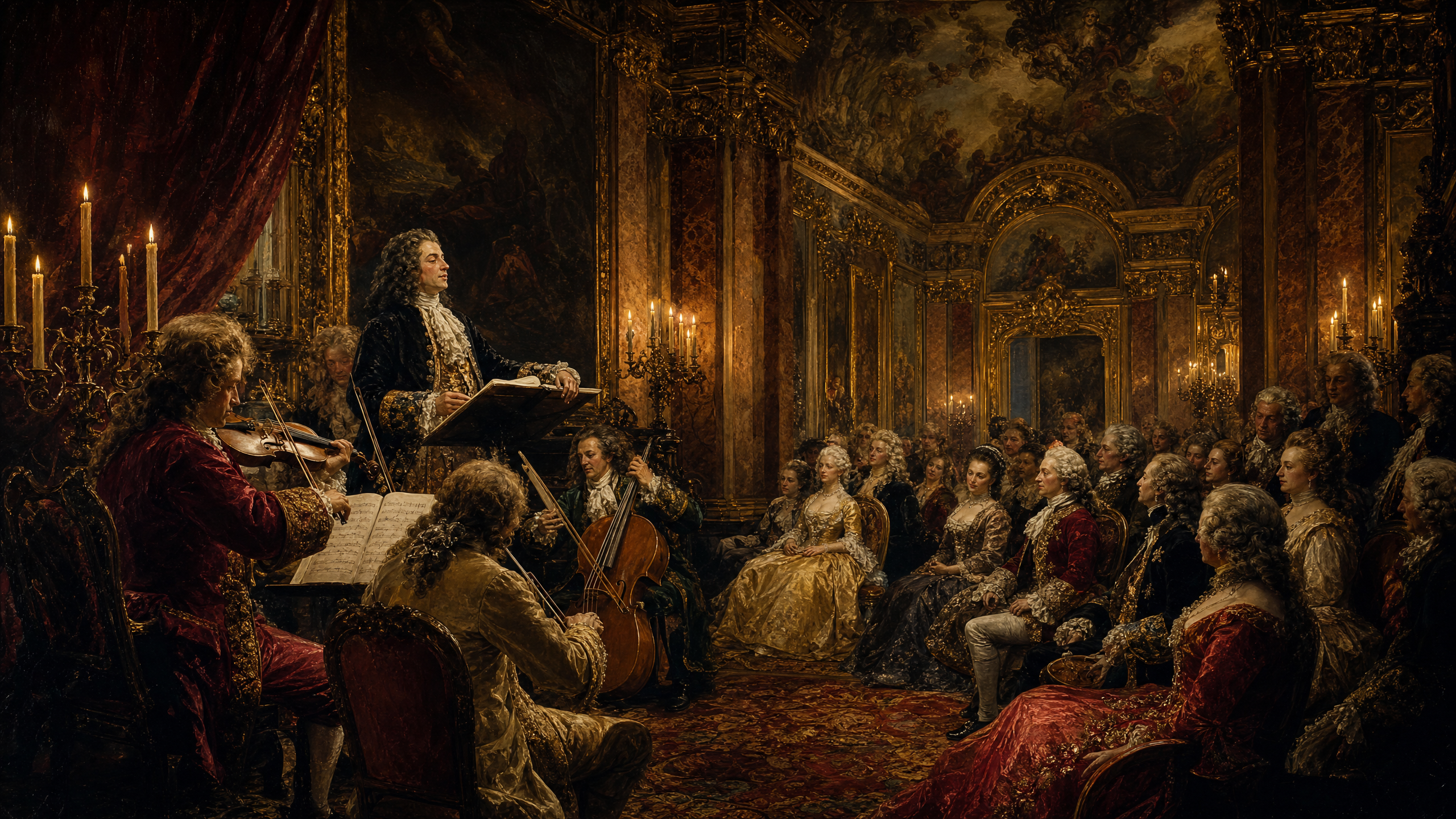
Bach and the Art of Divine Mathematics
How does a devout Lutheran church musician in 18th-century Germany create music that feels both mathematically perfect and spiritually transcendent? The answer lies in Bach's extraordinary life and genius.
Historical Context
The Lutheran church tradition and the patronage system of German courts in the early 18th century.
The Story
Johann Sebastian Bach spent most of his career as a church musician and court composer in various German cities, composing an extraordinary volume of sacred and secular music. His Brandenburg Concertos, composed around 1721 as a gift to the Margrave of Brandenburg, represent the pinnacle of Baroque instrumental writing. Bach's music is remarkable for its intricate counterpoint, where multiple independent melodic lines weave together with mathematical precision while simultaneously achieving profound emotional depth, reflecting both the intellectual rigor and the deep religious faith of his era.
Deep Dive Essay
The full historical picture
Bach and the Art of Divine Mathematics
The year is 1721. Europe is a tapestry of shifting alliances and burgeoning empires, still reeling from the Thirty Years' War a generation prior. In the fragmented Holy Roman Empire, a patchwork of principalities and electorates, life is governed by a strict social hierarchy and, for many, the unwavering tenets of the Lutheran Church. This is a world where faith and reason are not yet seen as opposing forces, but rather as complementary paths to understanding God's intricate design. Princes and dukes, often with a taste for the arts, maintained lavish courts, employing musicians, artists, and scholars to enhance their prestige. Music was not merely entertainment; it was a reflection of order, a demonstration of intellectual prowess, and often, a direct expression of piety. It was within this rich, complex environment of spiritual devotion and aristocratic patronage that one of history's greatest musical minds flourished: Johann Sebastian Bach.
Bach, a devout Lutheran, spent much of his career navigating the dual demands of the church and the court. By 1721, he was Kapellmeister at the court of Prince Leopold of Anhalt-Cöthen, a position that afforded him considerable freedom to compose secular instrumental music. It was during this fruitful period that he compiled a set of six concertos, an elaborate gift for Christian Ludwig, Margrave of Brandenburg-Schwedt. These were not commissioned works, but rather a grand gesture, perhaps an audition for a future position, or simply a testament to Bach's boundless creativity. The Brandenburg Concerto No. 3 in G Major stands out among them for its sheer vitality and ingenious construction. It's a piece that, at first listen, feels like a joyous, intricate dance, but beneath the surface lies a profound architectural brilliance.
What makes the Third Brandenburg Concerto so captivating is its unique instrumentation and the way Bach uses it. Instead of a single soloist, Bach divides the orchestra into three groups of three: three violins, three violas, and three cellos, all supported by a continuo of bass and harpsichord. These nine string instruments don't just play together; they engage in a lively, intricate conversation, passing melodic fragments back and forth, weaving complex patterns that seem to unfold with effortless grace. This is counterpoint at its most exhilarating: multiple independent melodies intertwining, each maintaining its own identity while contributing to a glorious whole. It’s a musical equivalent of a perfectly engineered clock, where every gear and spring moves with purpose, creating a mechanism of breathtaking precision and beauty. The piece’s two fast movements are separated by a mere two chords, an invitation for improvisation, a fleeting moment of contemplation before the exhilarating chase resumes.
The Brandenburg Concerto No. 3 is more than just a brilliant piece of music; it is a sonic window into the mind of its creator and the world he inhabited. It reflects the era's fascination with order, balance, and the divine harmony believed to underpin the universe. Bach, through his "divine mathematics," crafted music that was both intellectually rigorous and deeply moving, a testament to his belief that music was a means of glorifying God. For a modern listener, this concerto offers an unparalleled opportunity to experience the joy and ingenuity of Baroque music, reminding us that even in an age of strict social structures and profound religious conviction, human creativity could soar to astonishing heights, creating art that transcends time and speaks to the enduring power of human expression.
The Piece
Brandenburg Concerto No. 3
Johann Sebastian Bach
THE & CO. SERIES
See Also in This Era
The same historical moment, seen through different creative lenses.
Pablo & Co.
Visual Art
Caravaggio, Rembrandt, and Rubens painted in the same dramatic chiaroscuro spirit as Bach and Handel composed.
Explore this era →
Ernest & Co.
Literature
Milton's Paradise Lost and Molière's plays were the literary voice of the same absolutist courts that commissioned Baroque music.
Explore this era →
Coco & Co.
Fashion
The elaborate wigs, brocades, and court dress of Versailles were the visual equivalent of Baroque musical ornamentation.
Explore this era →
Continue exploring
Back to Baroque Era