Handel's Messiah: When a King Stood Up
A piece of music so powerful that a king rose to his feet in reverence, starting a tradition that endures to this day. The story of Handel's Messiah is one of faith, ambition, and unexpected triumph.
Historical Context
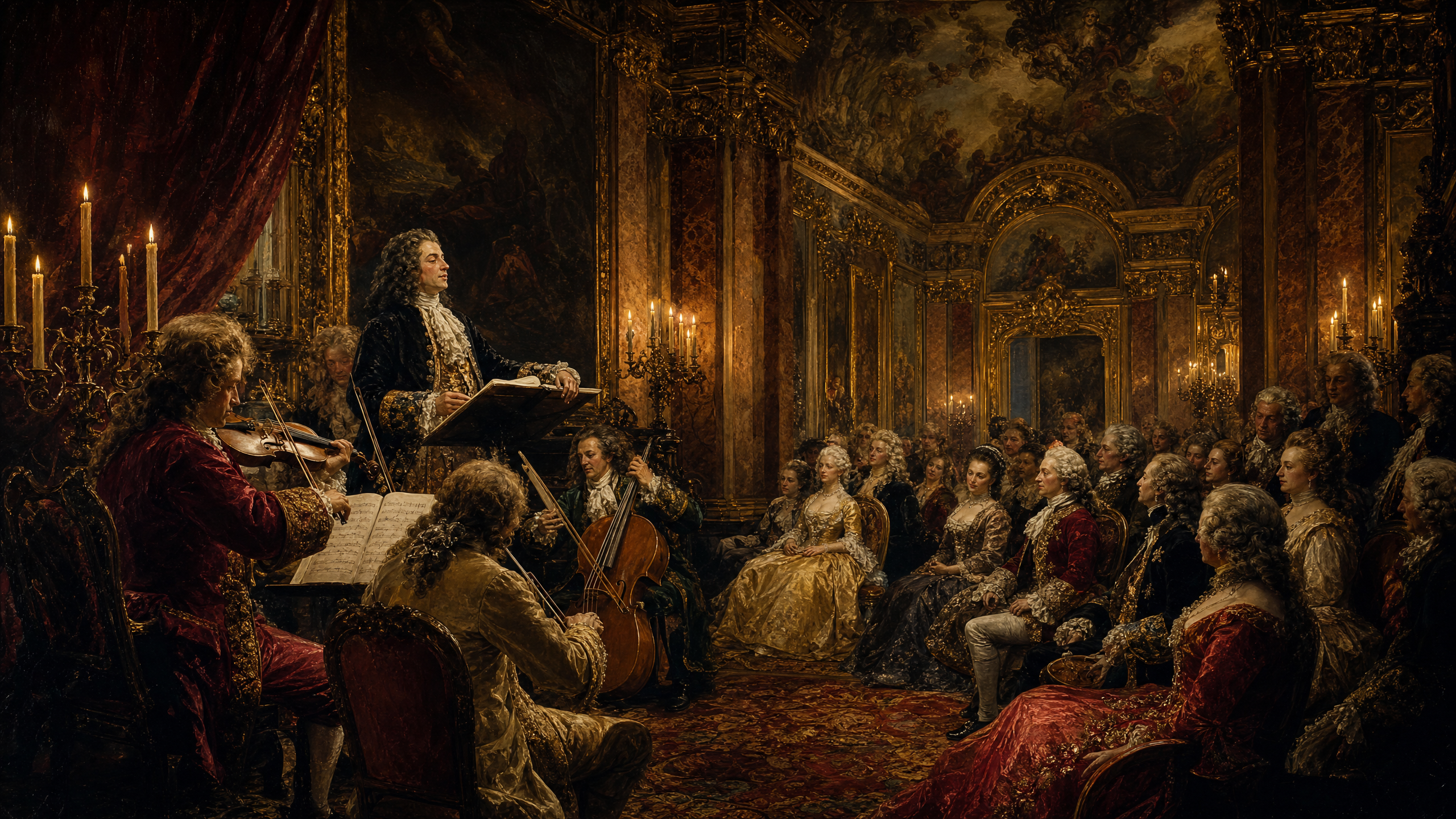
The premiere of Handel's Messiah in Dublin in 1742, and its subsequent London performances before the British royal family.
The Story
George Frideric Handel composed his oratorio 'Messiah' in just 24 days in 1741, reportedly in a state of divine inspiration. When it premiered in Dublin, it was an immediate sensation. The tradition of standing during the 'Hallelujah' chorus is said to have begun when King George II rose to his feet, moved by the music, and the audience followed. Whether legend or fact, the story captures the extraordinary power Handel's music had over its audiences, and 'Messiah' remains one of the most performed choral works in history.
Deep Dive Essay
The full historical picture
Handel's Hallelujah: When a King Stood Up
The World at the Time
Imagine London in the early 1740s. This was a city of burgeoning global power, a hub of commerce and culture, yet also a place of stark social divides. The Georgian era was in full swing, with King George II on the throne, a monarch more comfortable in his native Hanover than in England, and often viewed with a mixture of respect and mild disdain by his British subjects. Politically, the nation was navigating complex European alliances, often embroiled in conflicts like the War of the Austrian Succession. Culturally, the Enlightenment was gathering pace, emphasizing reason and individual experience, yet religious faith remained a powerful, shaping force in daily life. Public entertainment was a vibrant affair, from raucous theater to elegant concerts. Opera, particularly Italian opera, had long been the darling of London's elite, but its popularity was beginning to wane, leaving composers like George Frideric Handel to seek new avenues for their dramatic genius.
Across the Irish Sea, Dublin was a city of considerable importance, the second city of the British Empire, with its own vibrant intellectual and artistic scene. It was here, in 1742, that a new kind of musical experience would first captivate an audience. The concept of an oratorio, a large-scale musical work for orchestra, choir, and soloists, usually on a sacred theme, was gaining traction. Unlike opera, oratorios were unstaged, allowing the music and text to carry the entire dramatic weight. They offered a powerful blend of spiritual reflection and theatrical grandeur, perfectly suited to an age that valued both piety and spectacle.
The Composer and the Work
George Frideric Handel, by 1741, was a towering figure in European music, a German-born composer who had made England his adopted home and the center of his artistic universe. He was a man of immense talent, formidable energy, and a sometimes fiery temperament. His career had been a rollercoaster of triumphs and financial woes, largely tied to the fickle fortunes of Italian opera in London. Facing mounting debts and a changing public taste, Handel turned his prodigious talents towards the oratorio. The story goes that the composition of Messiah in the summer of 1741 was an almost miraculous feat, penned in a mere 24 days. Handel himself reportedly felt a profound spiritual connection to the work, particularly the "Hallelujah" chorus, which he is said to have composed in a state of ecstatic inspiration.
What makes the "Hallelujah" chorus so utterly captivating, even for those unfamiliar with classical music? It's a masterclass in musical storytelling and emotional build. Handel uses a technique called word painting, where the music vividly reflects the meaning of the text. When the choir sings "King of Kings, and Lord of Lords," the music ascends with a majestic, almost regal sweep. The textures shift constantly, from powerful, unison declarations to intricate, interwoven lines, building an unstoppable momentum. The sheer joy and triumph of the music are infectious, a celebration of divine victory that transcends its sacred origins to become a universal expression of elation. It is a piece designed to stir the soul and elevate the spirit, a testament to Handel's genius for crafting music that speaks directly to the human heart.
Why It Still Matters
The story of King George II standing during the "Hallelujah" chorus – whether entirely factual or a cherished legend – perfectly encapsulates the profound impact Handel's Messiah had, and continues to have. It speaks to a time when music was not merely entertainment, but a powerful force capable of moving even the most stoic of monarchs. This piece reveals the era's deep spiritual currents, its love for dramatic spectacle, and the burgeoning public concert culture. For a modern listener, the "Hallelujah" chorus remains a powerful reminder of music's ability to unite, to inspire, and to evoke a sense of shared human experience. It is a timeless anthem of hope and triumph, a testament to the enduring power of art to transcend its historical moment and resonate across centuries.
The Piece
Messiah: Hallelujah Chorus
George Frideric Handel
THE & CO. SERIES
See Also in This Era
The same historical moment, seen through different creative lenses.
Pablo & Co.
Visual Art
Caravaggio, Rembrandt, and Rubens painted in the same dramatic chiaroscuro spirit as Bach and Handel composed.
Explore this era →
Ernest & Co.
Literature
Milton's Paradise Lost and Molière's plays were the literary voice of the same absolutist courts that commissioned Baroque music.
Explore this era →
Coco & Co.
Fashion
The elaborate wigs, brocades, and court dress of Versailles were the visual equivalent of Baroque musical ornamentation.
Explore this era →
Continue exploring
Back to Baroque Era