1750–1820
Classical Era
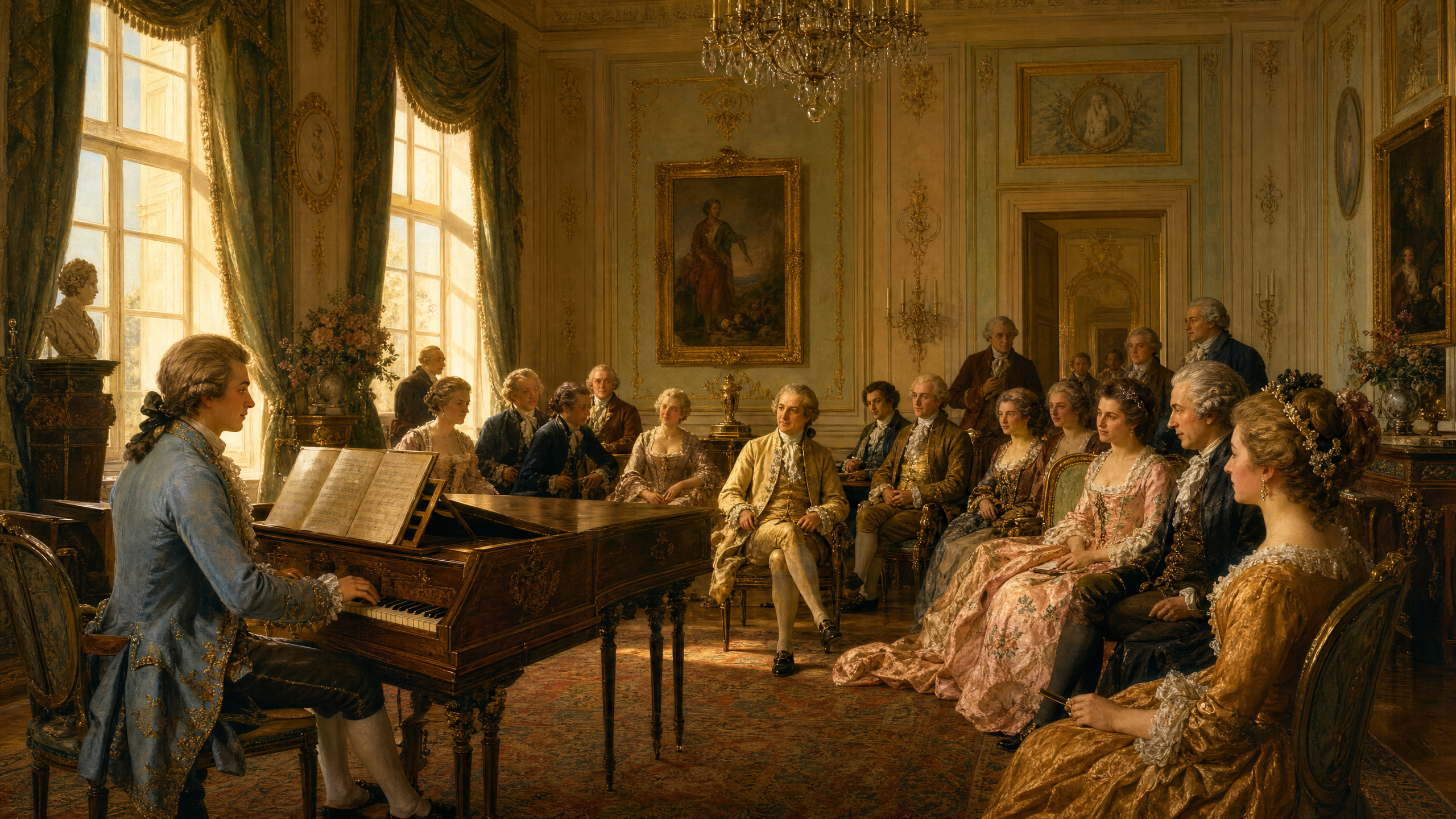
An age of elegant clarity and balanced form, where music mirrored the Enlightenment's pursuit of reason and universal appeal.
Composers
4
Stories
3
Listening Journey
4 pieces
The World
Historical Context
The Classical Era was profoundly shaped by the Age of Enlightenment, a philosophical movement emphasizing reason, individualism, and human rights. Major political upheavals like the American Revolution (1765–1783) and the French Revolution (1789–1799) challenged monarchical power and fostered the rise of a middle class. The Industrial Revolution brought technological advancements and societal shifts, moving culture from aristocratic courts to public spheres, creating a demand for art that was accessible and reflective of universal human sentiments.
The Sound
What to Expect
Classical music is characterized by its lighter, clearer texture and emphasis on melody, often described as 'homophonic' with a prominent tune supported by harmonies. It moves away from the complex counterpoint of the Baroque, favoring structural clarity, balanced phrases, and predictable forms. Composers introduced greater dynamic variety, creating music that feels elegant, refined, and emotionally expressive without being overly dramatic.
The Masters
Key Composers
History through music
Stories of the Age
The 'Surprise' That Woke the Audience
Imagine a packed concert hall, the music lulling the audience into a gentle slumber... then, a sudden, thunderous chord! Haydn's wit was as sharp as his genius.
Joseph Haydn
Symphony No. 94, 'Surprise'
Mozart's Revolutionary Marriage
A comedic opera that dared to satirize the aristocracy and champion the cleverness of commoners, sparking controversy just three years before the French Revolution.
Wolfgang Amadeus Mozart
The Marriage of Figaro
Beethoven's Eroica: A Hero Dethroned
A symphony so grand and revolutionary, it was initially dedicated to a figure who would soon become its composer's greatest disappointment. The story of Beethoven and Napoleon.
Ludwig van Beethoven
Symphony No. 3, 'Eroica'
Start here
Your Listening Journey
A curated sequence of pieces to guide you through this era, from the most accessible entry point to deeper explorations.
Symphony No. 94, 'Surprise'
Joseph Haydn
Why start here
A perfect introduction to Classical wit and form, with its famous unexpected loud chord that delights and engages listeners.
What to listen for
Pay attention to the clear, balanced melodies, the elegant structure, and of course, the 'surprise' in the second movement.
Eine kleine Nachtmusik
Wolfgang Amadeus Mozart
Why start here
One of the most recognizable and beloved pieces of classical music, it embodies Mozart's effortless grace and melodic genius.
What to listen for
Notice the charming, memorable melodies, the interplay between the string instruments, and the overall sense of lighthearted elegance.
Moonlight Sonata
Ludwig van Beethoven
Why start here
This iconic sonata showcases Beethoven's emotional depth and innovative approach to the piano, offering a glimpse into the emerging Romantic spirit.
What to listen for
Focus on the haunting, sustained melody in the first movement, the gentle flow of the arpeggios, and the dramatic contrast in the later movements.
The Marriage of Figaro Overture
Wolfgang Amadeus Mozart
Why start here
A brilliant and energetic overture full of sparkle and dramatic anticipation, perfectly setting the stage for Mozart's revolutionary opera.
What to listen for
Listen for the lively tempo, the intricate layering of instruments, and the sense of playful intrigue.
THE & CO. SERIES
See Also in This Era
The same historical moment, seen through different creative lenses.
Pablo & Co.
Visual Art
David's Oath of the Horatii and Canova's sculptures expressed the same Enlightenment ideals as Haydn and Mozart.
Explore this era →
Ernest & Co.
Literature
Voltaire, Rousseau, and Goethe were the intellectual companions of Mozart and Haydn in the Age of Reason.
Explore this era →
Coco & Co.
Fashion
The shift from Rococo excess to Neoclassical simplicity in dress mirrored the clarity and balance of Classical music.
Explore this era →