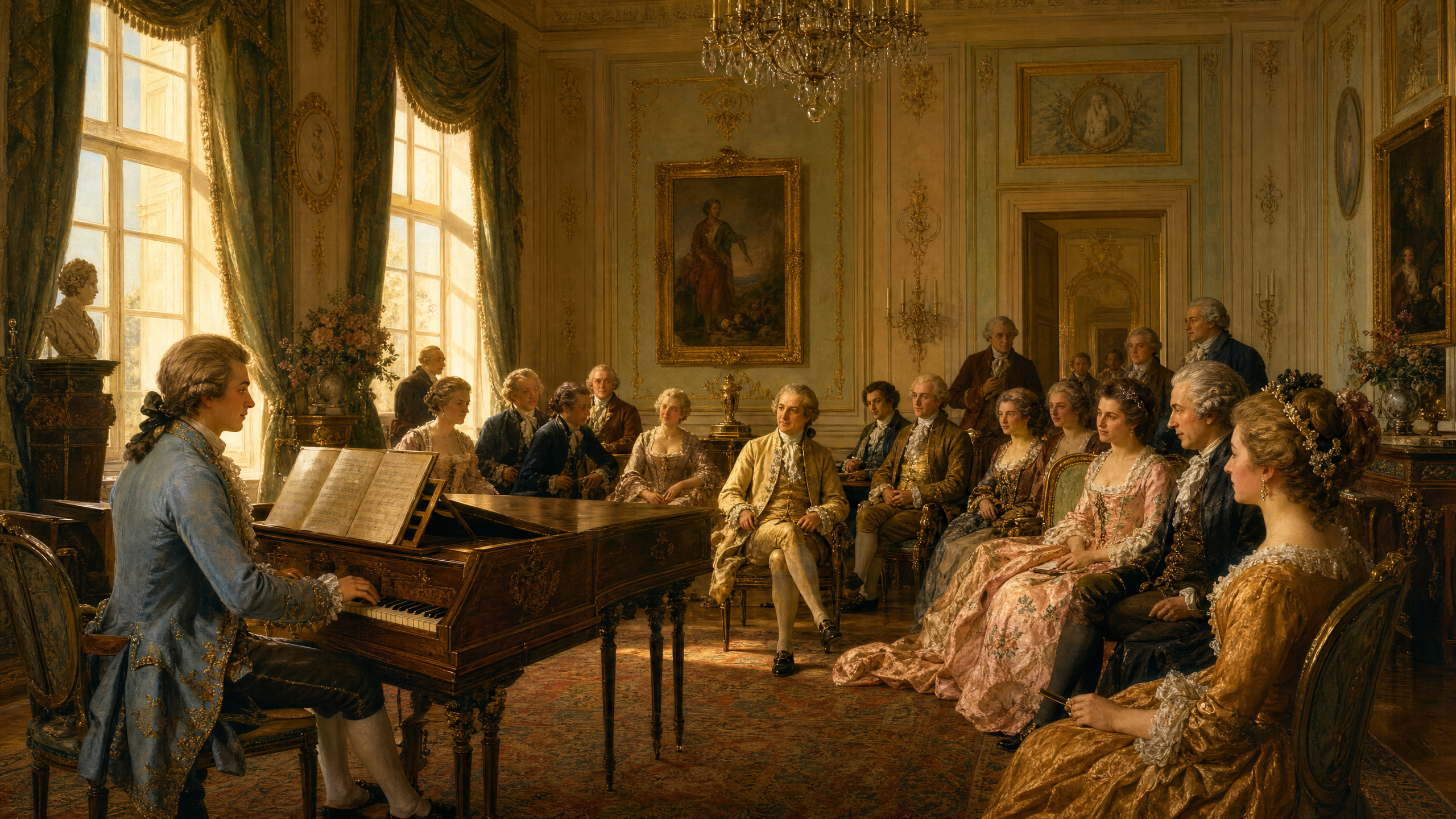
The 'Surprise' That Woke the Audience
Imagine a packed concert hall, the music lulling the audience into a gentle slumber... then, a sudden, thunderous chord! Haydn's wit was as sharp as his genius.
Historical Context
Public concerts and the rise of the middle-class audience in late 18th-century London.
The Story
In 1791, during his highly successful visits to London, Joseph Haydn composed his Symphony No. 94. Legend has it that he intentionally inserted a sudden, loud chord in the slow second movement to startle an audience prone to dozing off during quiet passages. This playful gesture was a nod to the growing public concert culture, where composers sought to engage and entertain a broader, often less musically educated, audience. It perfectly encapsulates the Classical era's blend of wit, accessibility, and structural innovation.
Deep Dive Essay
The full historical picture
The "Surprise" That Woke the Audience
Imagine London in 1791. The air crackled with the energy of a burgeoning empire. The French Revolution, though still in its bloody infancy, had sent ripples of both fear and radical thought across the Channel. King George III, though periodically unwell, still reigned, and Britain was a nation on the cusp of industrial transformation. This was a city of bustling markets, burgeoning coffee houses, and a rapidly expanding middle class with disposable income and a hunger for entertainment. No longer was music solely the preserve of aristocratic salons or church services. Public concerts, once a novelty, were becoming a staple of urban life. Entrepreneurs like Johann Peter Salomon, a German violinist and impresario, saw the opportunity to bring the greatest musical minds to the eager ears of Londoners, and in doing so, shaped the very landscape of musical performance.
It was into this vibrant, commercially driven metropolis that Joseph Haydn, already a celebrated figure across Europe, arrived. At nearly 60 years old, Haydn was a titan of the musical world, having spent decades in the service of the Esterházy princes in rural Hungary. But the allure of London, with its lucrative commissions and enthusiastic audiences, proved irresistible. Salomon had lured him with a generous contract, and Haydn, finally free from the strictures of court life, embraced his newfound celebrity. He was a rock star of his day, his every public appearance met with adulation. It was during this triumphant period that he composed his Symphony No. 94, now famously known as the "Surprise" Symphony.
The story goes that Haydn, a man of wit and good humor, noticed that some audience members, particularly during the quieter, more reflective slow movements, were prone to dozing off. Perhaps it was the comfortable warmth of the concert hall, or the lingering effects of a hearty dinner. Whatever the reason, Haydn, ever the showman, decided to inject a jolt of unexpected drama. In the second movement, a gentle, almost lullaby-like theme unfolds, delicate and unassuming. Then, without warning, a sudden, thunderous chord erupts from the full orchestra, a musical exclamation mark that must have sent many a slumbering listener bolt upright. This playful moment, far from being a mere gimmick, was a masterstroke of audience engagement, a direct acknowledgement of the evolving relationship between performer and public.
The "Surprise" Symphony, beyond its famous jolt, is a testament to Haydn's genius for structure and melody. Its clear, balanced forms, memorable tunes, and buoyant energy are hallmarks of the Classical era. It speaks to a time when composers were striving for clarity and accessibility, aiming to delight and entertain a broader audience without sacrificing artistic integrity. This piece, with its famous "surprise," perfectly encapsulates the spirit of its age: a blend of sophisticated artistry and good-natured populism. It reminds us that music, even in its most refined forms, has always been about connection, about stirring emotions, and sometimes, about a well-timed, delightful shock.
The Piece
Symphony No. 94, 'Surprise'
Joseph Haydn
THE & CO. SERIES
See Also in This Era
The same historical moment, seen through different creative lenses.
Pablo & Co.
Visual Art
David's Oath of the Horatii and Canova's sculptures expressed the same Enlightenment ideals as Haydn and Mozart.
Explore this era →
Ernest & Co.
Literature
Voltaire, Rousseau, and Goethe were the intellectual companions of Mozart and Haydn in the Age of Reason.
Explore this era →
Coco & Co.
Fashion
The shift from Rococo excess to Neoclassical simplicity in dress mirrored the clarity and balance of Classical music.
Explore this era →
Continue exploring
Back to Classical Era