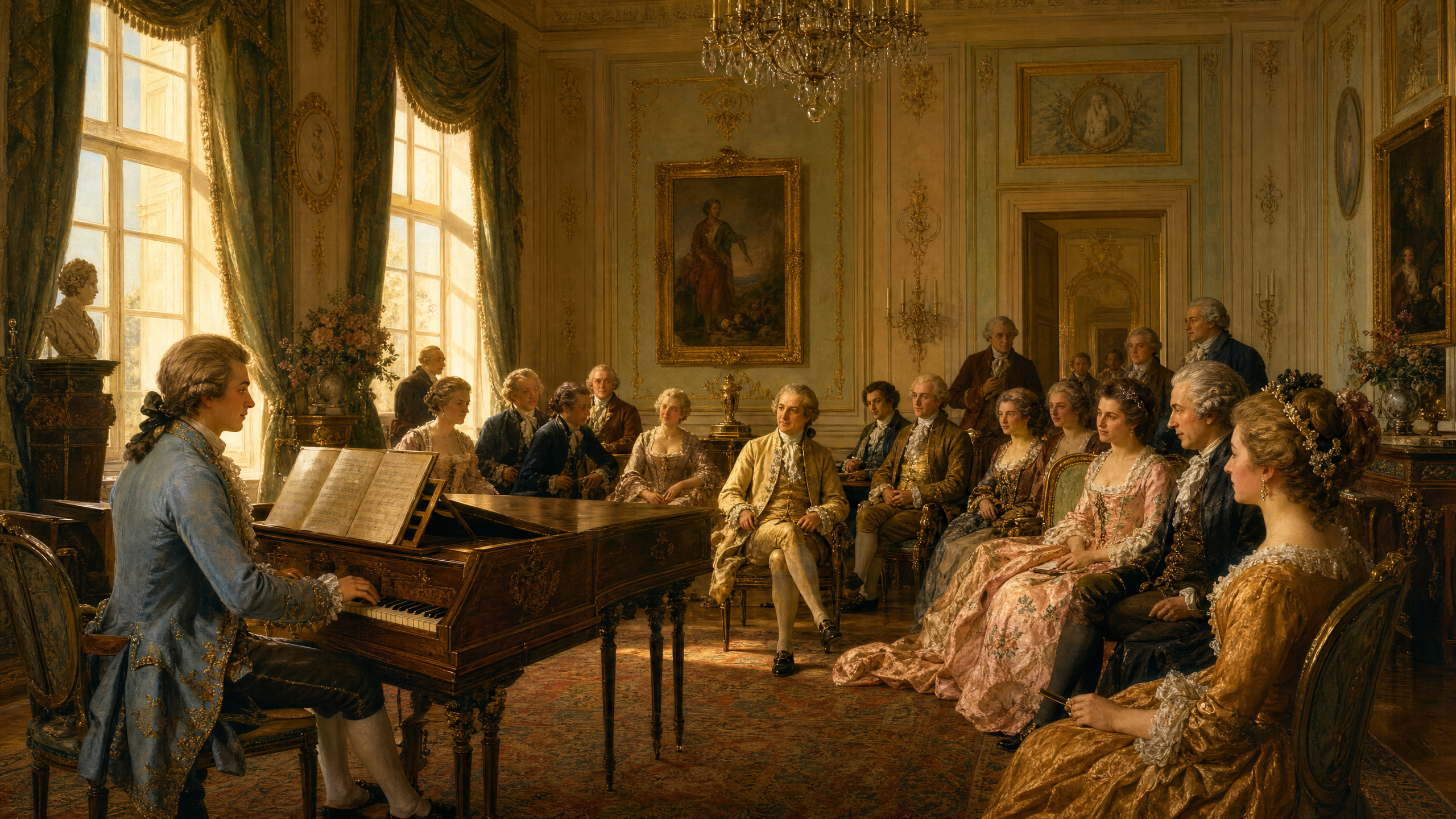
Beethoven's Eroica: A Hero Dethroned
A symphony so grand and revolutionary, it was initially dedicated to a figure who would soon become its composer's greatest disappointment. The story of Beethoven and Napoleon.
Historical Context
The Napoleonic Wars and the rise and fall of Napoleon Bonaparte's image as a liberator.
The Story
Beethoven originally dedicated his monumental Third Symphony, 'Eroica' (Heroic), to Napoleon Bonaparte, whom he initially admired as a champion of republican ideals. However, upon hearing that Napoleon had crowned himself Emperor in 1804, Beethoven furiously scratched out the dedication, feeling betrayed by the tyrant. This act symbolizes the Enlightenment's disillusionment with authoritarianism and Beethoven's own fiercely independent spirit, reflecting the turbulent political landscape and the shifting perceptions of heroism during the early 19th century.
Deep Dive Essay
The full historical picture
Beethoven's Eroica: A Hero Dethroned
The World at the Time
The turn of the 19th century was a whirlwind of revolution and war. Europe, still reeling from the French Revolution's promise of liberty, equality, and fraternity, found itself locked in the brutal embrace of the Napoleonic Wars. From 1803 to 1815, battlefields across the continent ran red with blood, as the forces of monarchical old Europe clashed with the revolutionary fervor embodied by Napoleon Bonaparte. This Corsican artillery officer, who had risen with meteoric speed through the ranks, was initially seen by many, especially those of the Enlightenment generation, as a beacon of progress. He championed legal reform, meritocracy, and the dismantling of aristocratic privilege, embodying the very ideals that had ignited the French Revolution. For intellectuals and artists across Europe, Napoleon was not merely a general; he was a liberator, a modern-day Roman consul bringing order and reason to a chaotic world.
Yet, this era was also a crucible for new ideas. The Enlightenment, with its emphasis on individual rights and reason, had reshaped intellectual landscapes. The concept of "heroism" itself was undergoing a profound transformation. No longer solely the domain of mythical figures or divinely appointed kings, the hero could now be a man of action, a champion of the people. It was into this heady mix of idealism and conflict that a young, fiery composer in Vienna was pouring his prodigious talent.
The Composer and the Work
Ludwig van Beethoven, then in his early thirties, was already a force of nature. Though grappling with the terrifying onset of deafness, his creative powers were at their peak. He was a man of fierce independence, deeply imbued with the Enlightenment's ideals. He believed passionately in human freedom and the power of the individual spirit. It was this spirit that drew him to Napoleon. Beethoven saw in Bonaparte a kindred soul, a revolutionary figure who dared to challenge the old order. He envisioned a symphony, grand and unprecedented in its scale, as a tribute to this modern hero. This was to be his Symphony No. 3, a work that would shatter the conventions of the classical symphony.
Completed in 1804, the "Eroica" Symphony was a musical earthquake. It was longer, louder, and more emotionally charged than anything that had come before it. The opening chords, two thunderous blasts, immediately announce a new era. The first movement, a vast and complex landscape, unfolds with a sense of epic struggle and triumph. The slow second movement, a profound and moving funeral march, speaks of loss and remembrance, perhaps even foreshadowing the sacrifices of war. The symphony's sheer audacity, its dramatic shifts in mood, and its unprecedented emotional depth were a direct reflection of Beethoven's own revolutionary spirit and his vision of a heroic struggle.
Then came the news that shattered Beethoven's admiration: Napoleon had crowned himself Emperor of France. The liberator had become a tyrant. In a fit of rage, Beethoven famously scratched out the dedication on the title page so violently that he tore through the paper. The symphony, originally titled "Bonaparte," was now simply "Sinfonia Eroica... composed to celebrate the memory of a great man." The hero, in Beethoven's eyes, was dead.
Why It Still Matters
The "Eroica" Symphony stands as a monumental testament to an era of profound change. It reveals the fervent idealism of the Enlightenment and the bitter disillusionment that followed when those ideals were betrayed. Beethoven's act of striking out Napoleon's name is more than a personal anecdote; it is a powerful symbol of artistic integrity and the enduring human struggle against authoritarianism. For a modern listener, the "Eroica" is not just a piece of music; it is a visceral journey through the hopes and heartbreaks of a revolutionary age. It reminds us that heroism is not static, and that even the most celebrated figures can fall from grace. It is a timeless narrative of human ambition, betrayal, and the enduring power of the individual spirit to create something truly monumental, even in the face of profound disappointment.
The Piece
Symphony No. 3, 'Eroica'
Ludwig van Beethoven
THE & CO. SERIES
See Also in This Era
The same historical moment, seen through different creative lenses.
Pablo & Co.
Visual Art
David's Oath of the Horatii and Canova's sculptures expressed the same Enlightenment ideals as Haydn and Mozart.
Explore this era →
Ernest & Co.
Literature
Voltaire, Rousseau, and Goethe were the intellectual companions of Mozart and Haydn in the Age of Reason.
Explore this era →
Coco & Co.
Fashion
The shift from Rococo excess to Neoclassical simplicity in dress mirrored the clarity and balance of Classical music.
Explore this era →
Continue exploring
Back to Classical Era