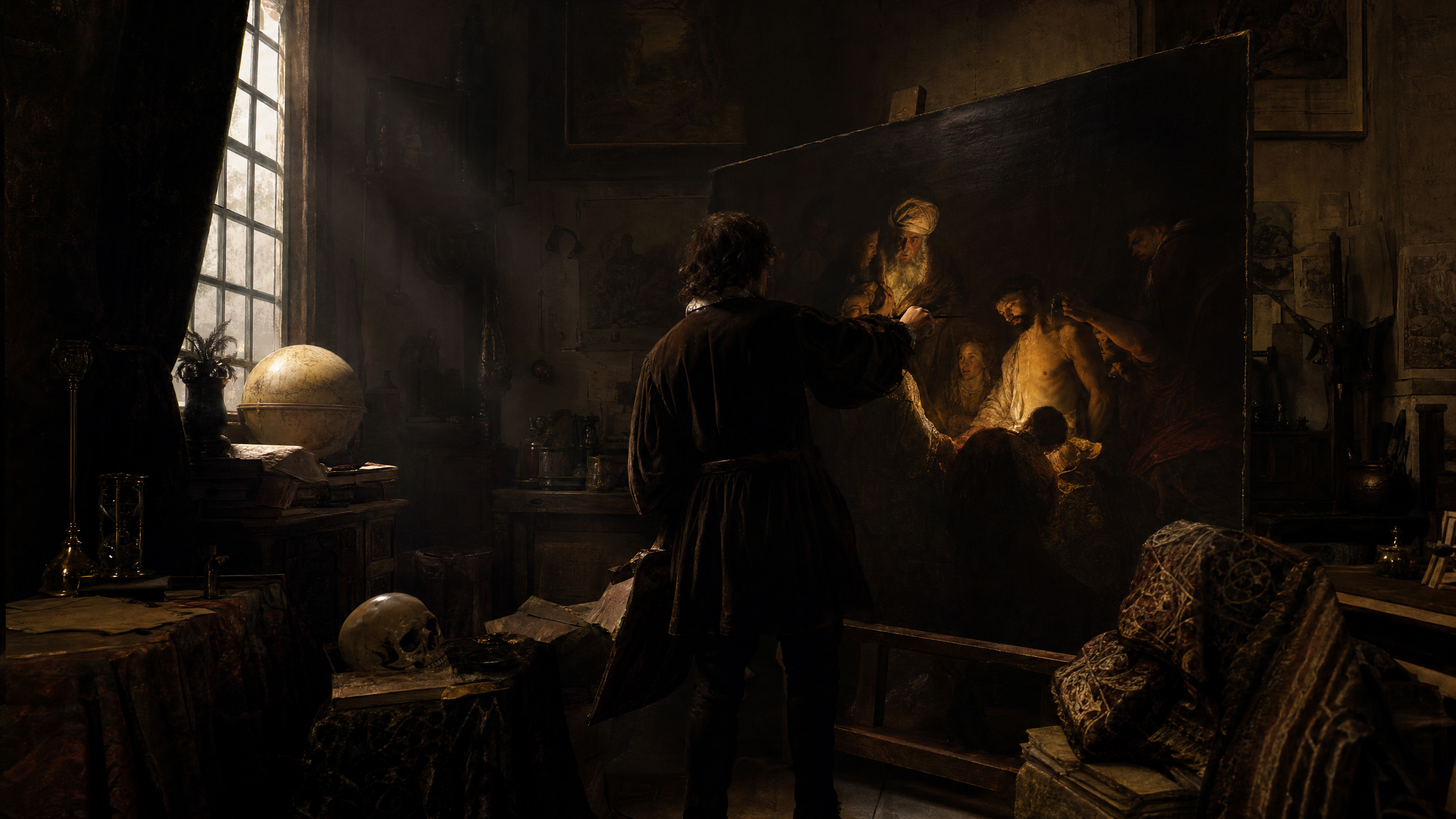
Divine Intervention in a Tavern: How Caravaggio's Masterpiece Rekindled Faith
Witness the dramatic moment a tax collector's life is transformed by a beam of light, reflecting the Catholic Church's powerful message during a turbulent era.
Historical Context
The Counter-Reformation
The Story
In the dimly lit confines of a Roman tavern, a mundane scene of tax collectors counting money is abruptly interrupted by a piercing ray of light. This is the moment Christ calls Matthew to discipleship in Caravaggio's 'The Calling of Saint Matthew'. Painted between 1599 and 1600, this work was a powerful instrument for the Counter-Reformation, the Catholic Church's response to the Protestant challenge. The Council of Trent had emphasized art's role in inspiring piety and making religious narratives accessible and emotionally resonant. Caravaggio's revolutionary use of chiaroscuro—dramatic contrasts of light and shadow—and his depiction of biblical figures in contemporary settings with raw realism, brought the divine down to earth. Viewers could see themselves in Matthew's place, experiencing the immediate and transformative power of faith, a message crucial for a Church striving to reaffirm its spiritual authority and connect with its congregation.
Deep Dive Essay
The full historical picture
Divine Intervention in a Tavern: How Caravaggio's Masterpiece Rekindled Faith
The World at the Time
Imagine Rome at the turn of the 17th century, a city still reeling from the shockwaves of the Protestant Reformation. For decades, the very foundations of the Catholic Church had been challenged, its authority questioned, and its faithful lured away by new doctrines. In response, the Church launched the Counter-Reformation, a vigorous campaign to reaffirm its spiritual power and win back souls. The Council of Trent, which concluded in 1563, had laid down clear directives: art was not merely decoration, but a potent weapon in this spiritual war. It needed to be clear, compelling, and emotionally resonant, capable of inspiring piety and making abstract religious narratives feel immediate and real. This was a time of intense religious fervor, political maneuvering, and a profound desire to reconnect with the divine in a tangible way. Rome, the Eternal City, became a stage for this grand drama, with popes and cardinals commissioning monumental works that would speak directly to the hearts of their congregations.
The streets of Rome bustled with life, a vibrant tapestry of merchants, pilgrims, and artists all vying for attention. It was a city of stark contrasts: opulent palaces stood alongside humble taverns, and the sacred often intertwined with the profane. This was the world that demanded a new kind of religious art, one that could bridge the gap between the divine and the everyday, making faith accessible to everyone, not just the learned elite. The Church understood that to truly reclaim its flock, it needed to speak a language that resonated with the common person, to show that salvation was not a distant ideal but a present possibility.
The Artist and the Work
Enter Michelangelo Merisi da Caravaggio, a name that would become synonymous with artistic revolution. By 1599, when he began work on "The Calling of Saint Matthew", Caravaggio was in his late twenties, a tempestuous and brilliant figure whose life was as dramatic as his paintings. He was already gaining notoriety for his unconventional approach, his refusal to idealize, and his preference for depicting raw human experience. He was a master of light and shadow, a technique known as chiaroscuro, which he employed not just for dramatic effect, but to imbue his scenes with profound psychological depth. He painted directly from life, using models from the streets of Rome, infusing his biblical figures with a startling, almost shocking, realism.
"The Calling of Saint Matthew," commissioned for the Contarelli Chapel in the Church of San Luigi dei Francesi in Rome, is a masterpiece of this revolutionary style. The scene unfolds in what appears to be a dimly lit Roman tavern, not a grand biblical setting. A group of men, dressed in contemporary clothing, are gathered around a table, counting money. The air is thick with the mundane, the scent of coins and human toil. Then, from the right, a beam of brilliant, almost blinding light slices through the darkness, illuminating the faces of the figures. Christ, almost hidden in the shadows, points directly at Matthew, the tax collector, who looks up, startled, his hand gesturing in a mixture of surprise and disbelief, as if to say, "Who, me?" The divine has burst into the everyday, unannounced and undeniable. Caravaggio's genius lies in making this miraculous moment feel utterly human, immediate, and relatable.
Why It Still Matters
Caravaggio's "The Calling of Saint Matthew" is more than just a painting; it is a testament to the power of art to shape belief and respond to the urgent needs of its time. For the Counter-Reformation Church, it was a perfect instrument. It spoke directly to the Council of Trent's directives, making a profound religious narrative accessible and emotionally resonant. Viewers could see themselves in Matthew's place, a sinner called to grace, experiencing the immediate and transformative power of faith. This message was crucial for a Church striving to reaffirm its spiritual authority and connect with a congregation that had grown distant. Today, the painting continues to captivate. It reminds us that moments of profound transformation can occur in the most unexpected places, amidst the ordinary clutter of life. It speaks to the enduring human search for meaning and the timeless power of a single gesture, a single ray of light, to change a destiny.
The Work
The Calling of Saint Matthew
Caravaggio
THE & CO. SERIES
See Also in This Era
The same historical moment, seen through different creative lenses.
Wolfgang & Co.
Classical Music
The elaborate ornamentation of Baroque fashion — wigs, brocades, lace — was the visual equivalent of Bach's counterpoint.
Explore this era →
Ernest & Co.
Literature
Molière, Racine, and Swift were writing in the same court culture that produced Baroque and Rococo fashion excess.
Explore this era →
Continue exploring
Back to Baroque & Rococo Art