Imperial Power and Divine Right in Mosaic
A Byzantine emperor's image, surrounded by a golden halo, asserts his God-given right to rule.
Historical Context
Reign of Emperor Justinian I and the assertion of Byzantine imperial authority
The Story
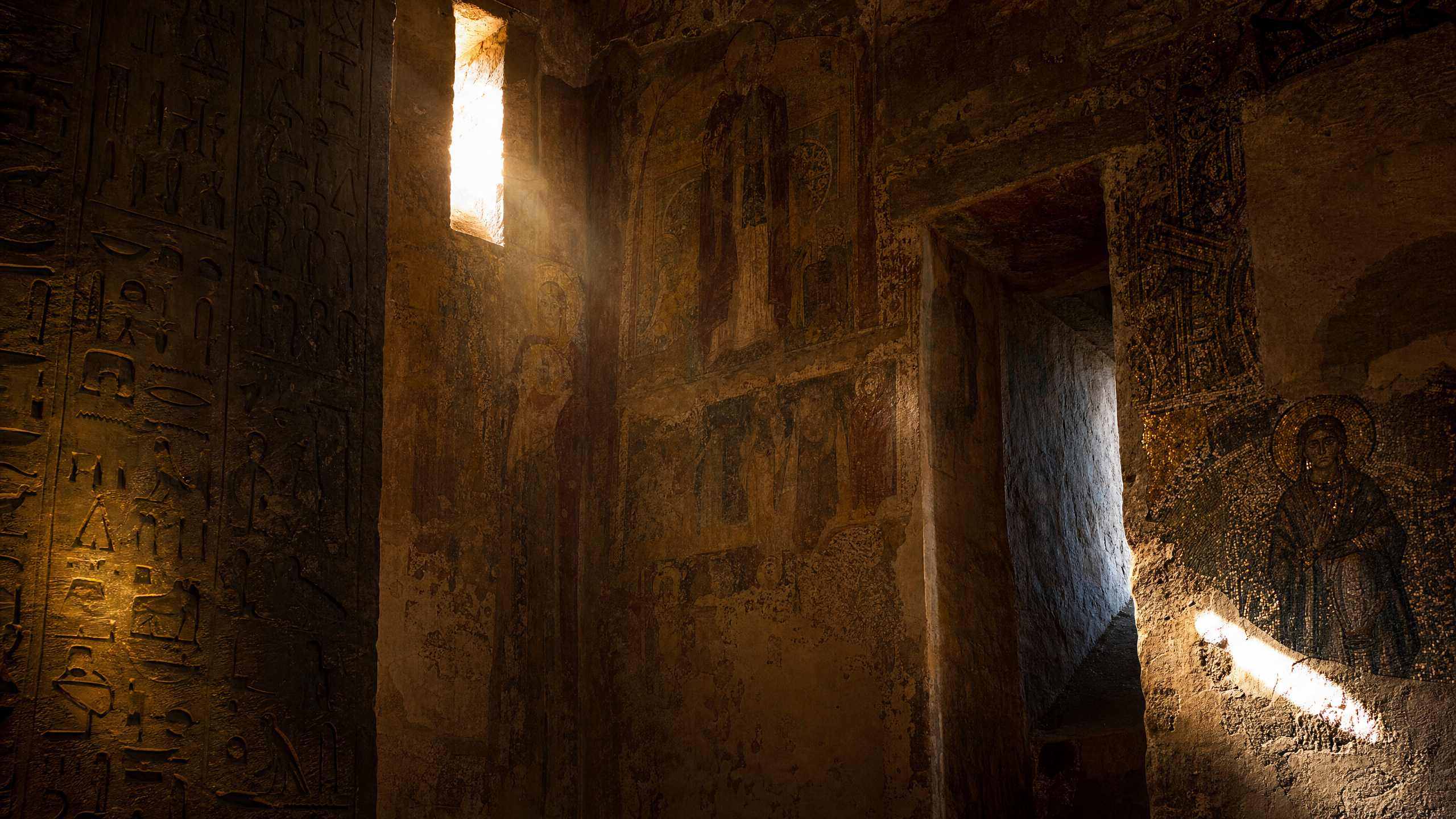
In the opulent San Vitale church in Ravenna, a shimmering mosaic from 547 CE captures Emperor Justinian I at the height of his power. Dressed in imperial purple and flanked by clergy and soldiers, Justinian is depicted with a halo, a visual cue typically reserved for holy figures. This artwork was not merely decorative; it was a potent political statement. It visually reinforced Justinian's divine right to rule, linking his earthly authority directly to God's will. In an era when the Byzantine Empire sought to reassert its dominance and Christian identity, this mosaic served as a constant reminder to parishioners of the emperor's sacred mandate and the unity of church and state.
Deep Dive Essay
The full historical picture
Imperial Power and Divine Right in Mosaic
The World at the Time
Imagine the year 547 CE. The city of Ravenna, on Italy's Adriatic coast, was a jewel in the crown of the Byzantine Empire. This was an empire with grand ambitions, led by the formidable Emperor Justinian I from his distant capital of Constantinople. Justinian was a man of immense vision, dreaming of restoring the glory of the old Roman Empire. His armies, led by the brilliant general Belisarius, had swept across North Africa and were now battling to reclaim Italy from the Ostrogoths. This was a time of immense upheaval and consolidation, where military might, political maneuvering, and religious conviction intertwined. The Byzantine Empire was not just a political entity; it was a Christian empire, and the emperor was seen as God's chosen representative on Earth, a concept known as "divine right." This belief was central to Justinian's authority and his grand projects, from legal reforms to monumental architecture.
Ravenna itself held a special significance. It had been the capital of the Western Roman Empire for a time and then the seat of Ostrogothic kings. When Justinian's forces recaptured it, the city became a powerful symbol of his ambition to reunite East and West under a single, Christian Roman banner. The construction and decoration of churches like San Vitale were not merely acts of piety; they were deliberate statements of imperial power, meant to awe and instruct the populace. Every shimmering tile, every carefully chosen image, served a purpose in this grand political and spiritual narrative.
The Artist and the Work
The "artist" behind the magnificent mosaic of Justinian, Bishop Maximianus, and attendants in San Vitale was not a single, named individual as we might think of a Renaissance master. Instead, we refer to them as "Anonymous (Byzantine)." This was a collective of highly skilled mosaicists, likely trained in workshops in Constantinople, who brought their sophisticated techniques and imperial iconography to Ravenna. These artisans were not driven by personal fame but by a deep understanding of their craft and its role in serving the emperor and the church. They were visual storytellers, translating complex theological and political ideas into enduring images. Their work was meticulous, using countless tiny tesserae, or colored glass and stone pieces, to create dazzling, light-reflecting surfaces.
The mosaic itself, located in the apse of San Vitale, is a breathtaking tableau. At its center stands Emperor Justinian, a regal figure in imperial purple, his gaze direct and unwavering. What immediately strikes the viewer is the halo encircling his head, an attribute traditionally reserved for Christ and saints. This is no mere decorative flourish; it is a profound declaration of his sacred status. He holds a golden paten, a vessel for the Eucharist, linking him directly to the sacred liturgy. To his right stands Bishop Maximianus, the local church leader, holding a jeweled cross. To his left are soldiers, their shields emblazoned with the chi-rho symbol, an early Christian monogram for Christ. The composition is carefully balanced, with Justinian at the apex, flanked by both spiritual and military authority. The figures are stylized, almost ethereal, their faces elongated and their bodies flattened, a characteristic of Byzantine art that emphasizes spiritual rather than earthly realism.
Why It Still Matters
This mosaic from San Vitale is far more than a beautiful ancient artwork; it is a profound window into the Byzantine world and the enduring power of art as propaganda. It reveals the absolute conviction in the concept of divine right, where the emperor's power was not just political but divinely ordained. For a modern viewer, it underscores how deeply intertwined church and state were in this era, and how visual culture was employed to reinforce that unity. The shimmering gold and the solemn faces were not just aesthetically pleasing; they were meant to inspire awe, obedience, and a sense of the emperor's omnipresent, sacred authority. This mosaic reminds us that art has always been a powerful tool for shaping beliefs and solidifying power, a testament to its enduring role in human history.
The Work
Justinian, Bishop Maximianus, and attendants (San Vitale)
Anonymous (Byzantine)
Continue exploring
Back to Ancient & Medieval Art