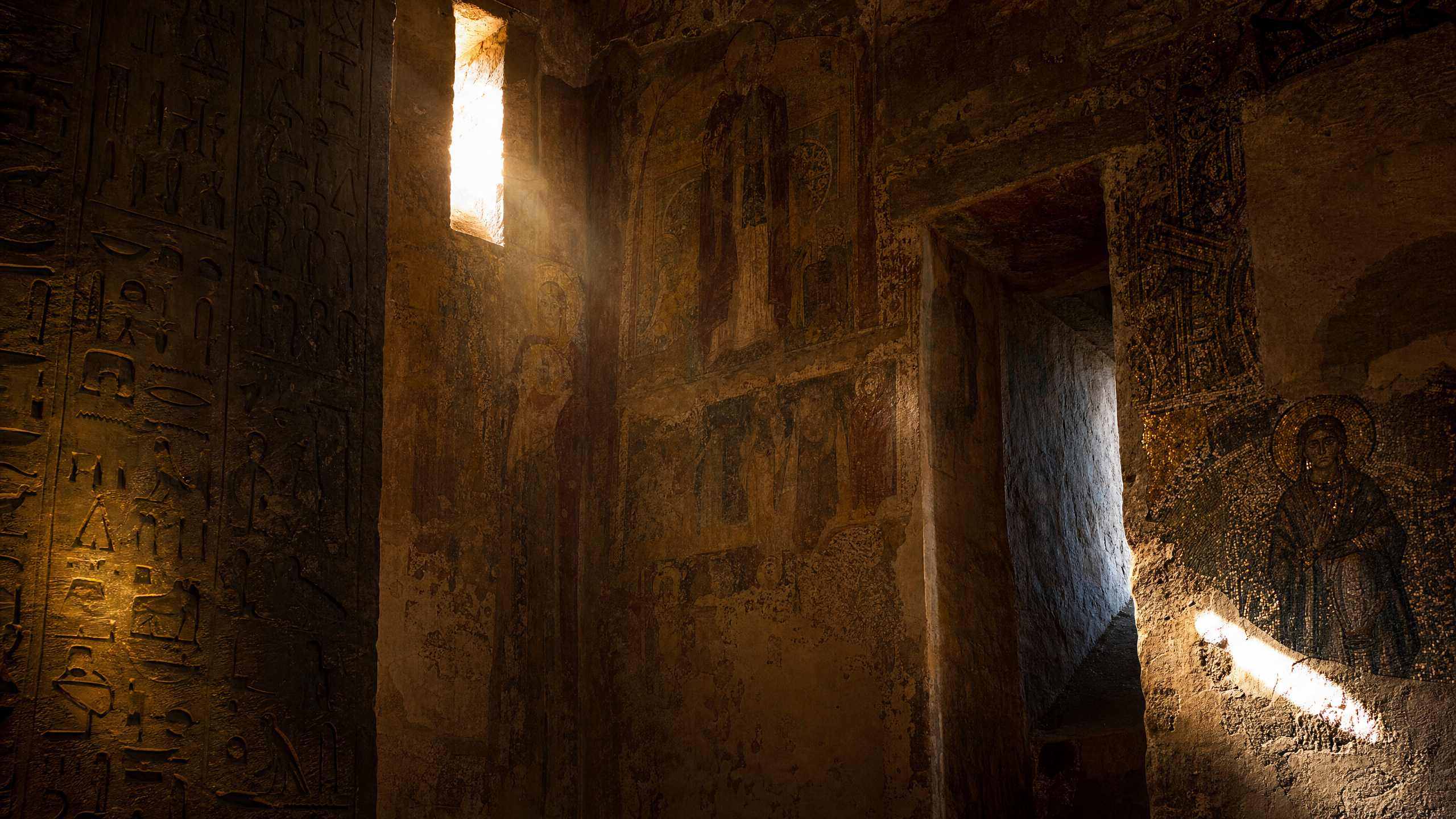
The Secret Sanctuary of Dura-Europos
In a hidden room, early believers defied persecution to express their faith through art.
Historical Context
Early Christian and Jewish persecution in the Roman Empire
The Story
In the 3rd century CE, as the Roman Empire still largely persecuted Christians and Jews, a house in the border town of Dura-Europos held a secret. Within its walls, a room was transformed into a synagogue, adorned with vibrant frescoes depicting biblical scenes like 'Samuel Anoints David'. This artwork, created at great personal risk, served as a powerful visual testament to faith in a time when open worship could mean death. It reveals the profound human need to connect with the divine and the resilience of belief in the face of oppression, offering a rare glimpse into the clandestine artistic expressions of early religious communities.
Deep Dive Essay
The full historical picture
The Secret Sanctuary of Dura-Europos
Imagine the 3rd century CE. The Roman Empire, a vast and often brutal machine, stretched its dominion across much of the known world. From the sun-baked sands of North Africa to the misty forests of Britannia, Roman legions enforced a Pax Romana, a peace often bought with iron and fire. In this sprawling empire, religious conformity was largely expected. The official pantheon of Roman gods, with Jupiter at its head, demanded veneration. To refuse was not just impious; it was an act of political defiance. For communities like the Jews, with their monotheistic faith, and the nascent Christians, whose radical beliefs challenged the very foundations of Roman society, this was a precarious existence. Persecution was not a distant threat but a chilling reality, often erupting in waves of state-sanctioned violence. In this charged atmosphere, on the very edge of the Roman world, where the empire met the Parthian and later Sasanian empires, lay the garrison town of Dura-Europos, a melting pot of cultures and beliefs.
Dura-Europos was a strategic outpost on the Euphrates River, a crossroads where Roman soldiers, Syrian merchants, and diverse communities mingled. Here, away from the direct gaze of Rome's central authority, a fragile tolerance sometimes bloomed. Yet, even in this relatively remote corner, the need for discretion was paramount. Open displays of non-Roman worship could attract unwanted attention, leading to harsh penalties. It was within this context of watchful coexistence and underlying danger that a remarkable act of faith and artistry took place.
The identity of the artist who painted the frescoes of the Dura-Europos Synagogue is lost to history, swallowed by the sands of time. This "Anonymous" artist was likely a member of the Jewish community in Dura-Europos, driven by a profound spiritual devotion and a desire to visually articulate the stories central to their faith. They were not a celebrated master working for imperial patrons, but rather an artisan, perhaps a local painter or even a congregant with a talent for brushwork, who transformed a humble house into a sacred space. The work, "Samuel Anoints David," is just one vibrant panel among many that adorned the walls of this secret synagogue. It depicts the prophet Samuel pouring oil over the head of the young David, an act of divine selection that would lead to David's kingship.
What is so striking about this work, and indeed all the Dura-Europos frescoes, is their vivid, almost narrative quality. The figures are rendered with a directness and emotional intensity, their eyes wide and expressive. The colors, surprisingly well-preserved after centuries underground, are bold and rich, a testament to the artist's skill and the community's investment in their sacred space. Unlike the more abstract or symbolic art of later periods, these frescoes tell stories in a clear, almost comic-book style, designed to educate and inspire a congregation that might not have been fully literate. The artistic style, while distinctly Roman in some aspects of its figural representation, also incorporates elements of Near Eastern art, reflecting the diverse cultural influences of Dura-Europos itself. The very act of creating such elaborate, figural art within a synagogue was revolutionary, challenging earlier interpretations of the Second Commandment against graven images.
The Dura-Europos Synagogue, and its powerful frescoes like "Samuel Anoints David," offers us an unparalleled window into the resilience of belief in the face of oppression. It reveals the profound human need to connect with the divine, even when doing so meant risking everything. For a modern viewer, this secret sanctuary is a poignant reminder that art has always been more than mere decoration; it is a vital expression of identity, a vessel for hope, and a silent testament to the enduring power of faith. It tells us that even in the darkest times, people found ways to celebrate their heritage and preserve their spiritual lives, leaving behind a legacy that continues to inspire and astonish us today.
The Work
Samuel Anoints David (Dura-Europos Synagogue)
Anonymous
Continue exploring
Back to Ancient & Medieval Art