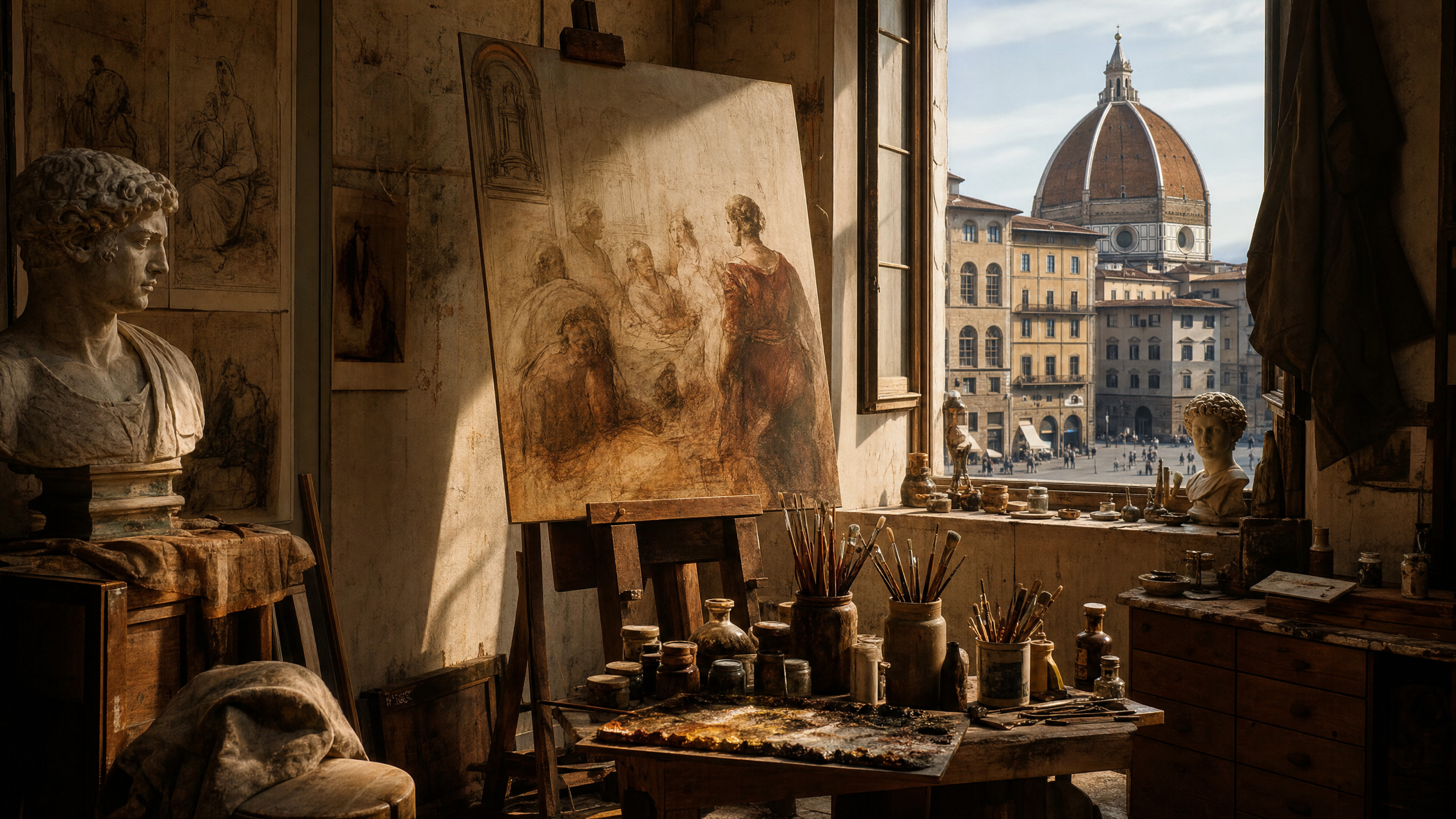
The Last Supper: A Moment of Betrayal Frozen in Time
Leonardo da Vinci's masterpiece captures the dramatic instant Christ reveals his impending betrayal, reflecting the intense religious and emotional climate of the late 15th century.
Historical Context
The religious fervor and political intrigue of the late 15th-century Italian city-states, particularly Milan under Ludovico Sforza.
The Story
Commissioned by Ludovico Sforza, Duke of Milan, for the refectory of Santa Maria delle Grazie, Leonardo's 'Last Supper' transcends a mere biblical depiction. It captures the precise moment Jesus announces one of his apostles will betray him, freezing the raw human emotion and psychological drama across the disciples' faces. This work reflects the intense religious devotion of the era, where biblical narratives were central to public life, but also the growing humanist interest in individual psychology and realistic portrayal. Leonardo's experimental fresco technique, which unfortunately led to its rapid deterioration, also speaks to the era's spirit of innovation and daring artistic exploration, often at the behest of powerful patrons seeking to immortalize their legacy through art.
Deep Dive Essay
The full historical picture
The Last Supper: A Moment of Betrayal Frozen in Time
The year is 1495. Milan, a glittering jewel among the Italian city-states, hums with the restless energy of the Renaissance. This is a world of opulent courts and cutthroat politics, where beauty and brutality often walked hand in hand. At the helm of Milan stands Ludovico Sforza, a duke known as "Il Moro" (The Moor) for his dark complexion, a man of immense ambition and refined taste. He navigated a treacherous landscape of alliances and betrayals, constantly vying for power against rivals like the Medici of Florence and the Borgia family in Rome. In this era, religious devotion was not merely a private affair; it was the very fabric of society, interwoven with political power and daily life. Grand cathedrals and humble chapels alike were testaments to a profound faith, and biblical narratives were the common language of art, literature, and public discourse.
It was into this vibrant, complex world that Ludovico Sforza commissioned a masterpiece for the refectory, or dining hall, of the Dominican convent of Santa Maria delle Grazie. He sought to immortalize his family's piety and prestige, and for this monumental task, he turned to a genius already making waves in Milan: Leonardo da Vinci. Leonardo, then in his early forties, was not just a painter; he was a polymath, a restless intellect driven by an insatiable curiosity about the natural world. He was an engineer, a sculptor, an anatomist, and a musician, constantly sketching, experimenting, and observing. For him, art was not just about depicting reality; it was about understanding its underlying principles.
Leonardo's "Last Supper" is not a static tableau; it is a psychological drama unfolding before our eyes. He chose the most electrifying moment: when Jesus declares, "One of you will betray me." The painting captures the immediate, visceral reactions of the twelve apostles, a wave of shock, denial, and confusion rippling down the long table. Each face is a study in human emotion, from the youthful anguish of John to the indignant protest of Peter, and the shadowed, clutching hand of Judas, already holding the bag of silver. Leonardo broke with tradition by placing Judas among the other disciples, not separated, making the betrayal even more poignant. He also abandoned the traditional fresco technique, which required rapid painting on wet plaster, for an experimental method using tempera and oil directly on the dry wall. This allowed him to achieve a luminous quality and intricate detail, but tragically, it also led to the painting's rapid deterioration, a testament to his daring innovation and the era's spirit of artistic exploration.
The "Last Supper" remains a profound window into the Renaissance. It reveals the era's deep religious conviction, where biblical stories were not just tales but living truths. Yet, it also showcases the burgeoning humanist interest in individual psychology and the realistic portrayal of human emotion, a hallmark of the period's intellectual awakening. For a modern viewer, it is a timeless exploration of betrayal, faith, and the complex tapestry of human relationships. Leonardo's genius lies in his ability to freeze a fleeting, emotionally charged moment, inviting us to contemplate not just a biblical event, but the universal drama of the human heart, a drama that continues to resonate centuries later.
The Work
The Last Supper
Leonardo da Vinci
Continue exploring
Back to Renaissance Art