From Blacking Factory to Literary Stardom
A twelve-year-old boy toils in a rat-infested factory, his childhood stolen by poverty. This early trauma would fuel his passionate critique of Victorian society.
Historical Context
The Marshalsea debtors' prison and child labor during the Industrial Revolution (1824)
The Story
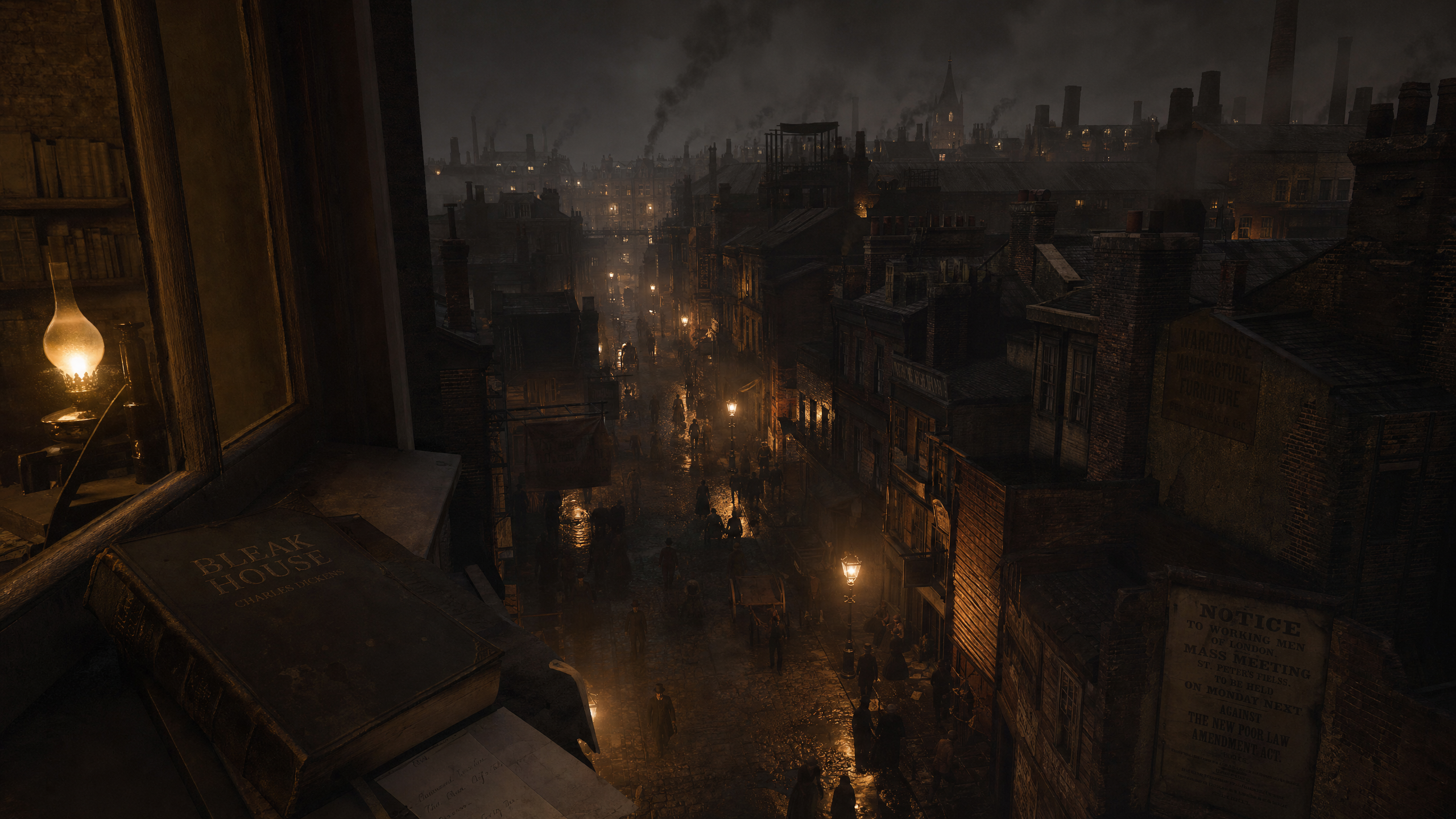
In 1824, Charles Dickens's father was incarcerated in the Marshalsea debtors' prison, a common fate for many during the economic upheavals of the Industrial Revolution. Young Charles, just twelve years old, was forced to leave school and work ten-hour days at Warren's Blacking Warehouse, pasting labels on pots of shoe polish. This period of intense hardship, loneliness, and humiliation deeply scarred him. The squalid conditions of the factory, the injustice of child labor, and the stark contrast between his family's former middle-class life and their sudden destitution became foundational experiences. These memories fueled his lifelong commitment to social reform and provided the raw material for his vivid portrayals of poverty, social injustice, and the plight of the working class in novels like *Oliver Twist*, *Bleak House*, and *Great Expectations*, making him a powerful voice for the voiceless in Victorian England.
Deep Dive Essay
The full historical picture
From Blacking Factory to Literary Stardom
Imagine London in 1824, a city groaning under the weight of the Industrial Revolution. Smoke belched from factory chimneys, painting the sky a perpetual grey. Fortunes were made and lost with dizzying speed, and beneath the glittering surface of progress lay a brutal reality for the working poor. This was a time of stark contrasts: opulent drawing rooms and overcrowded, disease-ridden slums. Child labor was not just common; it was an economic necessity for many families. Children as young as five toiled in factories, mines, and workshops, their small hands deemed perfect for intricate tasks, their bodies cheap and expendable. Debt, too, was a constant shadow. If you couldn't pay your bills, the Marshalsea debtors' prison awaited, a grim institution where families often followed their patriarchs, living in squalor until the debt was somehow discharged. It was a world where social safety nets were nonexistent, and individual suffering was often invisible to the powerful.
It was into this unforgiving landscape that Charles Dickens, a bright and sensitive twelve-year-old, was plunged. His father, John Dickens, a clerk with a penchant for living beyond his means, found himself incarcerated in the Marshalsea. The family's genteel middle-class life shattered. Young Charles was pulled from school and sent to work at Warren's Blacking Warehouse at Hungerford Stairs, pasting labels on pots of shoe polish for ten hours a day. The humiliation, the loneliness, the sheer injustice of it all burned an indelible mark on his soul. He witnessed firsthand the dehumanizing conditions of early industrial capitalism, the casual cruelty, and the desperate struggle for survival. This period, though brief, was the crucible in which his literary genius was forged.
Years later, as a celebrated author, Dickens poured these searing memories into David Copperfield, a novel he famously called his "favourite child." Published serially between 1849 and 1850, it is a semi-autobiographical masterpiece, a sprawling narrative of a young man's journey from a naive, orphaned boy to a successful writer. The character of David Copperfield himself endures a childhood remarkably similar to Dickens's own, including a stint in a bottling factory after his stepfather's financial ruin. Dickens, by then a master of character and plot, used his personal pain to create a vivid, compelling world filled with unforgettable figures: the tyrannical Mr. Murdstone, the eccentric Betsey Trotwood, the villainous Uriah Heep, and the ever-optimistic Mr. Micawber, a character widely believed to be based on Dickens's own father. The novel's distinctive blend of humor, pathos, and social critique made it an instant classic, championing the underdog and exposing the hypocrisies of Victorian society.
David Copperfield remains a powerful testament to the enduring impact of childhood trauma and the resilience of the human spirit. It reveals the harsh realities of child labor and the arbitrary cruelty of the debtors' prison system in 19th-century England, giving voice to the voiceless and shedding light on the dark corners of a rapidly industrializing society. For the modern reader, it is more than just a historical novel; it is a timeless exploration of identity, social justice, and the transformative power of storytelling. Dickens's work reminds us that even in the face of immense hardship, art can emerge, not only to entertain but to challenge, to provoke, and ultimately, to inspire change.
The Work
David Copperfield
Charles Dickens
Continue exploring
Back to Realism & Naturalism