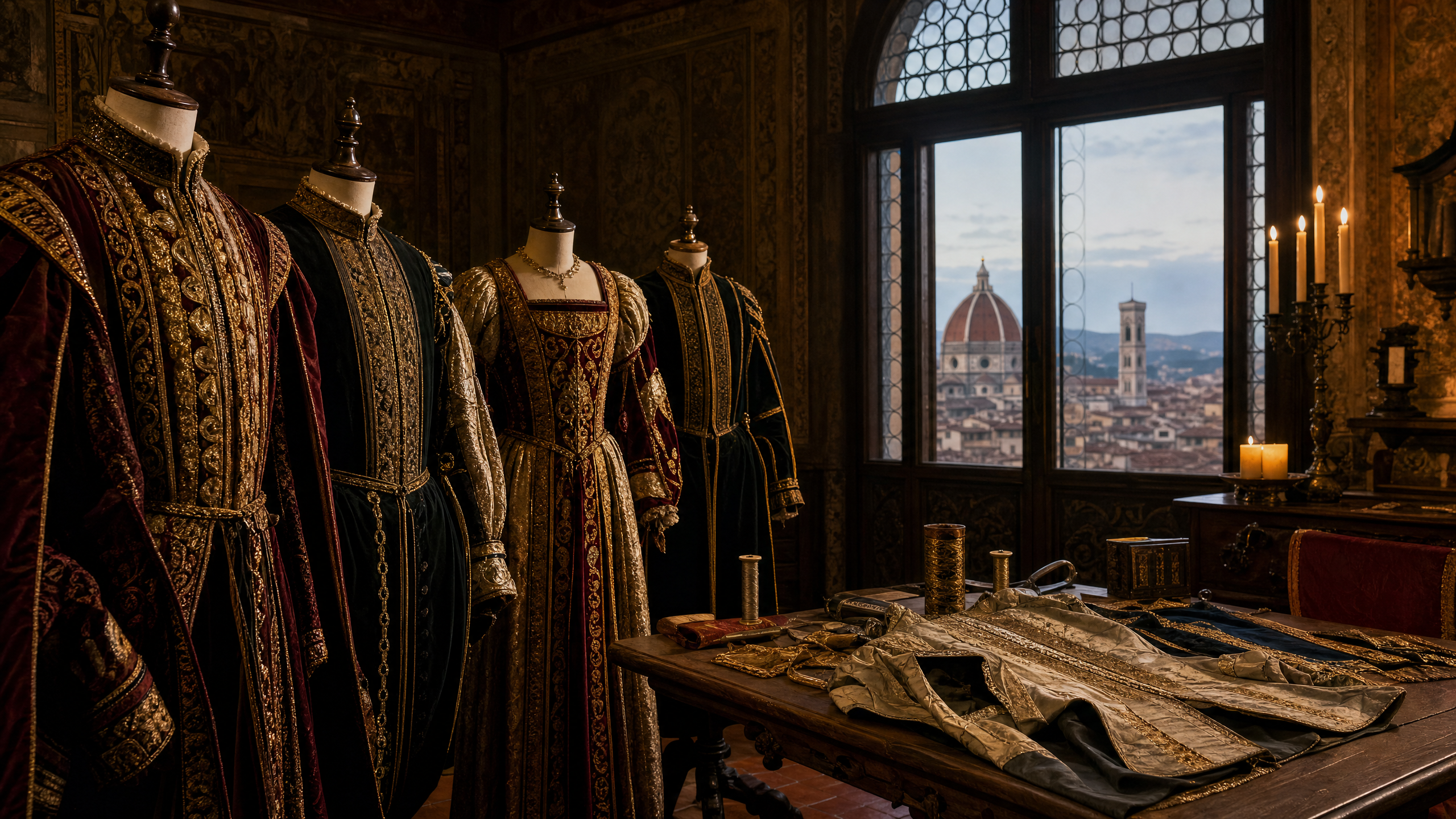
The Farthingale\'s Reign: Shaping the Female Silhouette
From Spain\'s conical \'verdugada\' to England\'s dramatic \'wheel farthingale,\' these rigid understructures dictated the extreme silhouettes of women\'s fashion, reflecting evolving ideals of beauty and social status.
Historical Context
Spanish influence, Elizabethan era, courtly display
The Story
The farthingale, a hoop skirt worn under gowns, emerged in late 15th-century Spain as the \'verdugada,\' creating a conical silhouette. Catherine de\' Medici introduced it to France, and it quickly spread to England, becoming a defining feature of Elizabethan fashion. By the late 16th century, the English \'wheel\' or \'drum\' farthingale pushed the skirt out horizontally from the waist, creating an exaggerated, almost architectural shape. These structures were not merely aesthetic; they were powerful symbols of status, as the voluminous and rigid skirts restricted movement, signaling that the wearer was a woman of leisure who did not engage in manual labor. The farthingale thus physically embodied the era\'s strict social hierarchies and the idealized, often impractical, female form.
Deep Dive Essay
The full historical picture
The Farthingale's Reign: Shaping the Female Silhouette
The World at the Time
Imagine Europe in the 16th century, a continent ablaze with ambition, exploration, and fierce religious and political rivalries. Spain, newly enriched by its ventures in the Americas, was a dominant global power under monarchs like Philip II. Its court was a crucible of innovation, setting trends that reverberated across the continent. Meanwhile, England, under the formidable Queen Elizabeth I, was asserting its own identity, navigating a delicate balance of power and cultivating a distinct national style. This was an age of grand gestures, where clothing was not merely covering but a potent declaration of status, wealth, and allegiance. Society was rigidly hierarchical, with every person's place meticulously defined, and nowhere was this more evident than in the elaborate rituals of court life.
Into this world of burgeoning empires and strict social codes stepped women of power. Their attire, far from being a private affair, was a public performance. The ideal female form was not one of natural ease, but of sculpted artifice, a canvas upon which the era's values were painted. The very architecture of their clothing spoke volumes about their position, their leisure, and their detachment from the toil of the common person.
The Designer and the Work
The "designers" of the farthingale were not singular, named individuals as we might think of a Christian Dior or a Coco Chanel today. Instead, they were the skilled, often anonymous, court tailors and seamstresses of Spain and later England. These artisans were at the pinnacle of their craft, translating the desires of their royal patrons into tangible garments. Their "career" was one of constant innovation, responding to the shifting whims of fashion and the demands of courtly display. They weren't driven by commercial profit in the modern sense, but by the prestige of serving the most powerful people in Europe, and the challenge of creating ever more elaborate and impressive silhouettes.
Their masterpiece, the "Evolution of the farthingale," began in late 15th-century Spain as the verdugada. This initial form was a simple, conical structure of hoops, often made of willow or whalebone, sewn into a petticoat. It gave the skirt a stiff, bell-like shape, a stark contrast to the softer, flowing lines of earlier periods. When Catherine de' Medici brought this Spanish innovation to the French court, it quickly spread, eventually reaching England. There, under Elizabeth I, it underwent a dramatic transformation. The English "wheel" or "drum" farthingale of the late 16th century pushed the skirt out horizontally from the waist, creating an almost tabletop-like flatness at the front and back. This was achieved with a padded roll or a series of hoops that projected outwards, making the wearer appear impossibly wide at the hips, an architectural marvel of fabric and structure.
Why It Still Matters
The farthingale, in all its iterations, was far more than just an undergarment; it was a profound statement about the woman who wore it and the society she inhabited. It physically restricted movement, making it impossible to perform manual labor, thus signaling the wearer's elevated status and leisure. It was a visual barrier, a personal space that demanded respect and distance, reinforcing the social hierarchy. This garment reveals an era where artifice was celebrated, where the body was molded to fit an ideal rather than the other way around. For a modern reader, the farthingale reminds us that fashion has always been a powerful language, reflecting and reinforcing the values, power structures, and ideals of its time. It shows us how clothing can be both beautiful and burdensome, a symbol of freedom for some and a cage for others, forever shaping our understanding of history through the very fabric of life.
The Garment
Evolution of the farthingale
Spanish and English court tailors
Continue exploring
Back to Renaissance & Early Modern Fashion