Historical Context
The world that shaped this fashion
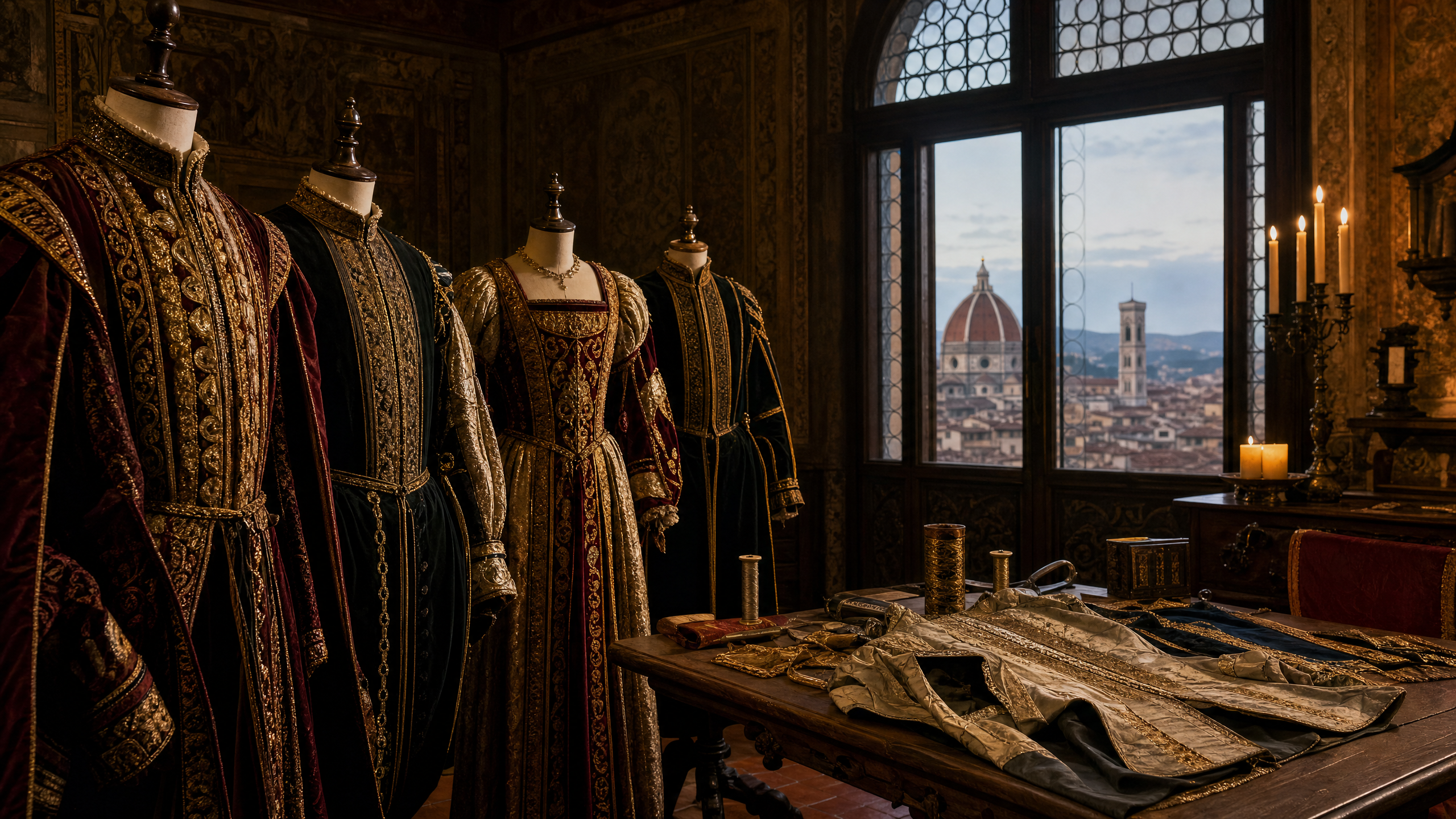
The Renaissance and Early Modern period, spanning from 1400 to 1700, was a transformative era marked by profound political, social, and cultural shifts that directly shaped fashion. The 15th century saw Europe grappling with conflicts like the Hundred Years\' War and the Wars of the Roses, while the opulent Burgundian court, under figures like Philip the Good, became a dominant fashion center, influencing styles across Northern Europe. Italian city-states like Florence and Venice flourished as hubs for luxury textiles, leading to the widespread adoption of sumptuary laws to regulate dress based on social status. The late 15th and early 16th centuries witnessed the Italian Wars, which exposed French nobility to Italian styles. The early 16th century was defined by powerful monarchs such as Henry VIII of England, Francis I of France, and Charles V, Holy Roman Emperor, whose courts vied for sartorial splendor, exemplified by events like the Field of Cloth of Gold. The influx of wealth from the New World, coupled with the Protestant Reformation, further fueled a desire for opulent yet sometimes somber attire, particularly under Spanish influence. The late 16th century was dominated by the Elizabethan era in England, characterized by increased extravagance and strict social hierarchies reflected in dress. The early 17th century saw the English Civil War, which fostered a divergence between elaborate courtly styles and the more sober clothing favored by Puritans, demonstrating how political and religious upheavals directly impacted sartorial choices.
Fashion Character
Fashion in the Renaissance and Early Modern period was a dynamic reflection of power, gender, class, and identity, evolving from experimental 15th-century forms to highly structured and opulent 17th-century styles. Early on, voluminous houppelandes and elaborate headdresses like the hennin defined the silhouette. The 16th century introduced a wide, often rigid silhouette, with women\'s conical farthingales and men\'s broad, padded shoulders. Rich fabrics such as silks, velvets, and brocades, often adorned with intricate embroidery, slashing, and applied trims, were paramount. The ruff emerged as a dominant feature, evolving from a simple neck frill to an elaborate, starched, and often wired accessory. Bodices were stiffened with boning and busks, creating a flattened torso. Colors ranged from vibrant hues in Italy to more somber, rich tones under Spanish influence. Sleeves were a focal point, often puffed, slashed, and cuffed to reveal contrasting linings or chemises. Headwear, from gable hoods to French hoods, indicated social status and regional identity. The period emphasized a display of wealth and status through luxurious materials, complex construction, and exaggerated forms, with fashion serving as a powerful visual language in a rapidly changing world.
Key Figures
The designers who defined the age
Fashion meets history
Stories behind the garments
The Rise of the Ruff: A Symbol of Status and Constraint
From a humble neck frill to an architectural marvel, the ruff became the ultimate statement of wealth and social standing, yet it also imposed rigid physical and social constraints.
Spanish Black: The Austere Opulence of a Global Empire
As Spain\'s empire expanded, its preference for somber black garments, achieved through expensive dyes, became a powerful fashion statement across Europe, signifying piety, power, and understated luxury.
The Farthingale\'s Reign: Shaping the Female Silhouette
From Spain\'s conical \'verdugada\' to England\'s dramatic \'wheel farthingale,\' these rigid understructures dictated the extreme silhouettes of women\'s fashion, reflecting evolving ideals of beauty and social status.
Curated style journey
Where to start looking
The Houppelande
Burgundian Court
This voluminous outer garment defines early 15th-century fashion, showcasing the transition from medieval practicality to early Renaissance extravagance.
What to look for
Notice its sweeping, often floor-length sleeves, high collar, and rich fabrics like velvet or brocade, which communicated status and warmth.
The Elizabethan Ruff and Farthingale
Elizabeth I and her court
These iconic elements epitomize the highly structured, opulent, and symbolic fashion of the late 16th century, reflecting England\'s power and Queen Elizabeth\'s personal style.
What to look for
Observe the ruff\'s intricate pleating and size, and the farthingale\'s dramatic silhouette, noting how they constrained movement and emphasized wealth through material and craftsmanship.
The Cavalier Style
Charles I and his court
This style represents the shift in the early to mid-17th century towards a more relaxed, yet still elegant, aesthetic, contrasting with the rigidity of the Elizabethan era.
What to look for
Focus on the wide-brimmed hats with feathers, soft lace collars (replacing ruffs), long hair, and less restrictive silhouettes, reflecting a more romantic and aristocratic ideal.
AI-powered