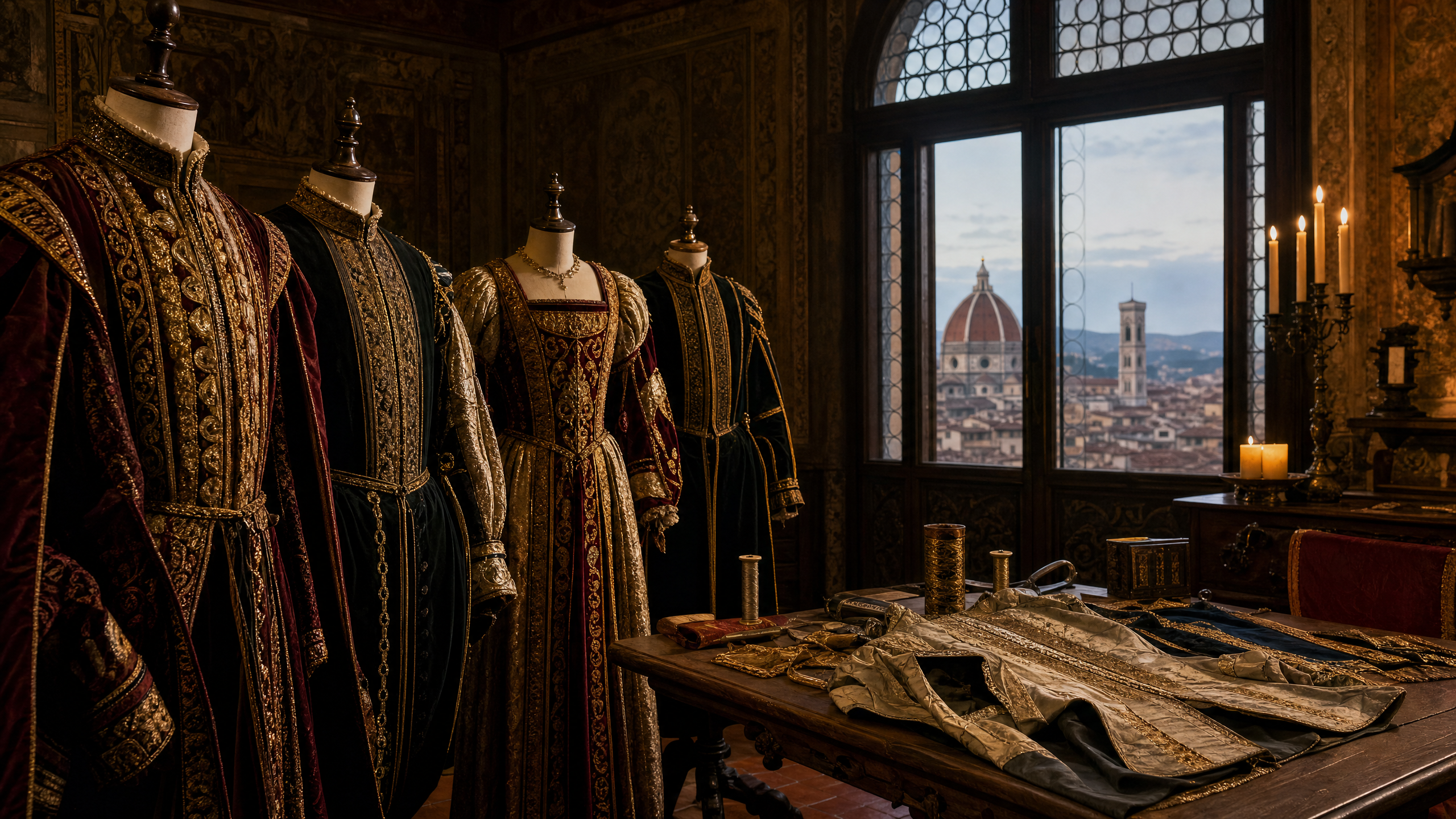
Spanish Black: The Austere Opulence of a Global Empire
As Spain\'s empire expanded, its preference for somber black garments, achieved through expensive dyes, became a powerful fashion statement across Europe, signifying piety, power, and understated luxury.
Historical Context
Spanish Empire, Protestant Reformation, Charles V\'s reign
The Story
The mid-16th century saw the rise of Spanish fashion, heavily influenced by the vast wealth flowing from the New World and the devout Catholic sensibilities of rulers like Charles V and Philip II. This led to a widespread adoption of black as a fashionable color, particularly for formal wear. Far from being a symbol of mourning, this \'Spanish black\' was a mark of extreme opulence. Achieving a deep, lasting black required expensive dyes and skilled craftsmanship, making it a luxury only the elite could afford. This austere yet rich aesthetic spread across Europe, influencing courts from England to the Low Countries, projecting an image of sober power, religious devotion, and immense wealth without overt flashiness, contrasting sharply with the vibrant hues of earlier Italian fashion.
Deep Dive Essay
The full historical picture
Spanish Black: The Austere Opulence of a Global Empire
The World at the Time
Imagine the mid-16th century, a time of immense upheaval and staggering wealth. Europe was a chessboard, and Spain, under the formidable Charles V, then his son Philip II, was a king with an unprecedented reach. From the silver mines of Potosí in the New World, a torrent of riches flowed into Spanish coffers, funding vast armies and an empire upon which the sun truly never set. This was not just a political and economic powerhouse; it was a deeply Catholic one, locked in religious conflict with the burgeoning Protestant Reformation. Piety, power, and prosperity were intertwined, shaping every aspect of life, including what people wore. The vibrant, often flamboyant silks and brocades of Renaissance Italy, once the height of fashion, now seemed almost frivolous in comparison to the somber, yet undeniably powerful, aesthetic emerging from the Spanish court.
This was a world of stark contrasts: glittering gold from the Americas against the shadow of religious wars, absolute monarchy alongside nascent scientific inquiry. Spain, with its vast global network, was at the epicenter of these changes. Its influence was not merely military or economic; it was cultural, and nowhere was this more evident than in the clothes worn by its elite. The Spanish Hapsburgs, with their austere piety and immense power, became the arbiters of style, dictating a new visual language for the European aristocracy.
The Designer and the Work
The "designer" in this case was not a single individual, but rather the collective will of the Spanish Court and its highly skilled tailors. These master craftsmen, working under the exacting standards of monarchs like Charles V and Philip II, were tasked with translating imperial ideology into wearable art. Their masterpiece was the widespread adoption and refinement of "Spanish black" as the ultimate statement of power and prestige. This wasn't merely any black; it was a deep, lustrous, almost velvety black that absorbed light, giving the wearer an aura of impenetrable authority.
What made this black so distinctive, and so coveted, was its extraordinary cost and complexity. Achieving such a rich, lasting hue required rare and expensive dyes, often derived from oak galls and iron salts, and a meticulous, multi-stage dyeing process that only the most expert artisans could execute. Unlike simple, faded blacks, Spanish black was a testament to technological prowess and boundless resources. It was applied to luxurious fabrics like velvet, silk, and fine wool, often tailored into stiff, structured garments with high ruffs and padded sleeves, creating a silhouette that was both imposing and restrained. Far from being a color of mourning, this black was a deliberate rejection of overt flashiness, a silent declaration of wealth so immense it didn't need to shout with bright colors. It projected an image of sober devotion, unshakeable authority, and an almost intimidating self-control.
Why It Still Matters
The dominance of Spanish black reveals a profound truth about its era: that fashion is never just about clothes; it's a visual manifesto. In a world grappling with religious schism and the expansion of global empires, Spanish black communicated a powerful message of unwavering Catholic piety, immense wealth, and unyielding imperial authority. It was a calculated aesthetic choice that projected seriousness and gravitas, a stark contrast to the more flamboyant styles that preceded it. For a modern reader, this story reminds us that even seemingly simple choices, like a color, can carry deep cultural and political meaning. It shows how fashion can be a tool for projecting soft power, influencing not just what people wore, but how they perceived an empire, making it a fascinating lens through which to understand the complex interplay of power, religion, and identity in the early modern world.
The Garment
Dominance of black attire
Spanish Court and its tailors
Continue exploring
Back to Renaissance & Early Modern Fashion