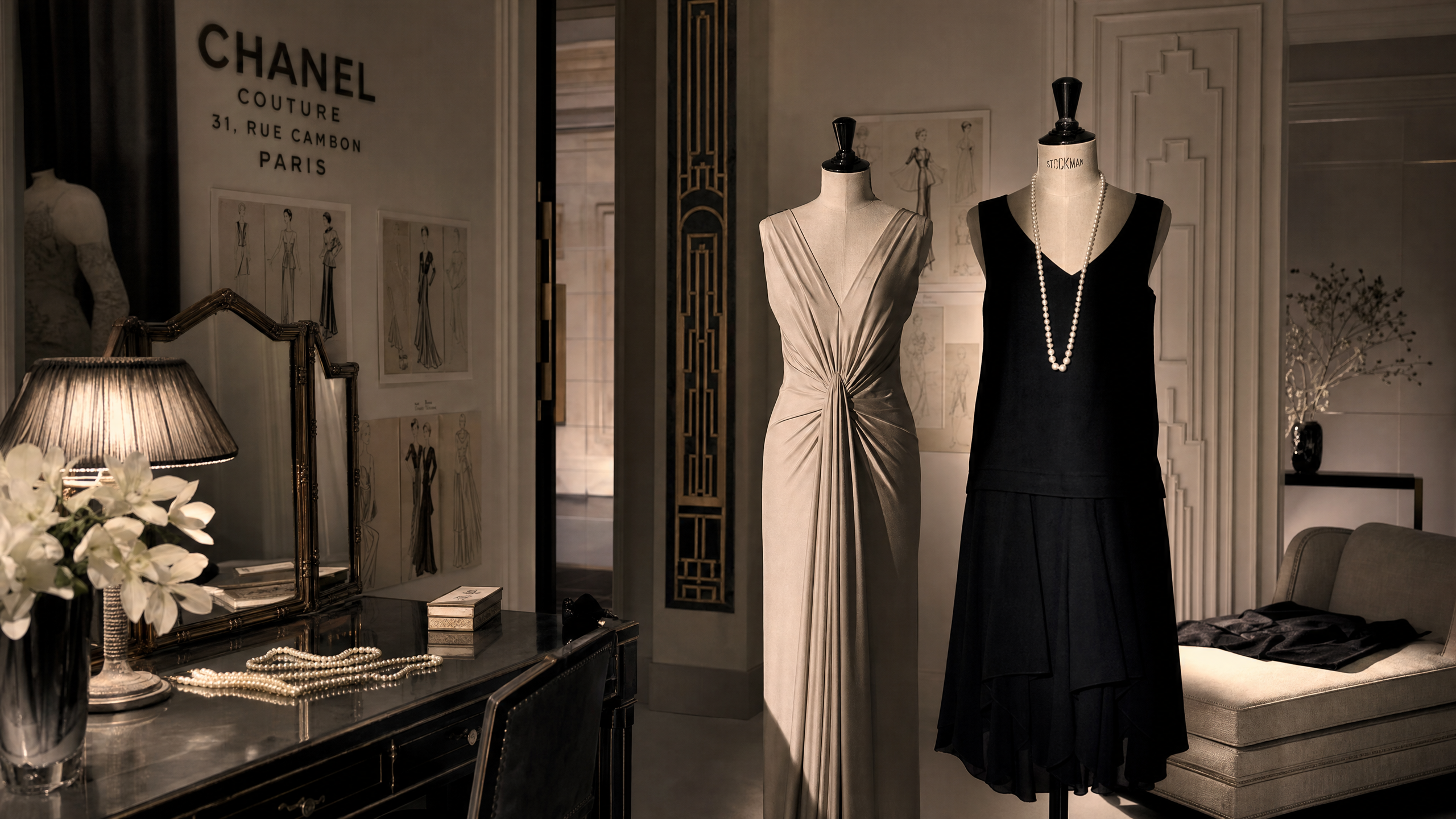
Art Deco's Geometric Glamour
The sleek lines and geometric patterns of Art Deco permeated fashion, transforming garments into wearable works of modern art.
Historical Context
The interwar period, rise of modern art and architecture
The Story
The Art Deco movement, which flourished between the two World Wars, was a celebration of modernity, luxury, and technological progress. Its influence on fashion was profound, moving away from organic Art Nouveau curves to sharp, geometric lines, streamlined silhouettes, and opulent ornamentation. Designers like Madeleine Vionnet, with her masterful bias cut, created dresses that draped elegantly, emphasizing the body's natural form with a modern sensibility. Jeanne Lanvin incorporated intricate beadwork and embroidery in geometric patterns. This aesthetic was seen in everything from evening gowns to accessories, reflecting the era's fascination with industrial design, exoticism, and the glamorous, fast-paced lifestyle depicted in films and magazines. It was a visual language of sophistication and progress.
Deep Dive Essay
The full historical picture
Art Deco's Geometric Glamour: A Symphony of Style and Progress
The world between the two World Wars, roughly from 1918 to 1939, was a fascinating crucible of change. Europe, scarred but not broken by the Great War, was eager to embrace a new future. The roaring twenties were a whirlwind of social liberation, symbolized by the flapper, jazz music, and a burgeoning sense of modernity. Women, having stepped into new roles during the war, were shedding the corsets and constraints of the past, demanding freedom in their lives and their wardrobes. This era saw the rise of mass media, with cinema and glossy magazines showcasing a glamorous, fast paced lifestyle that captivated imaginations. In art, movements like Cubism and Futurism shattered traditional perspectives, celebrating speed, machinery, and geometric forms. Cities like Paris and New York became vibrant hubs of innovation, where art, architecture, and fashion converged in a dazzling display of progress.
It was against this backdrop that the Art Deco movement blossomed, a visual language of sophistication and optimism. Its influence on fashion was profound, moving away from the organic curves of Art Nouveau to embrace sharp, clean lines and streamlined silhouettes. Two titans of French haute couture, Madeleine Vionnet and Jeanne Lanvin, became pivotal in translating this new aesthetic into wearable art. Vionnet, often hailed as an architect of the body, was a master of the bias cut. This revolutionary technique involved cutting fabric diagonally across the grain, allowing it to drape and flow with unparalleled elegance. Her dresses, often unlined and seemingly simple, hugged the body in a way that was both sensual and liberating, emphasizing natural form with a modern sensibility. They were the epitome of understated glamour, relying on the fabric's inherent beauty and the cut's flawless execution.
Jeanne Lanvin, on the other hand, brought a different kind of Art Deco opulence to her designs. While Vionnet championed minimalism, Lanvin delighted in intricate ornamentation. Her creations often featured exquisite beadwork, embroidery, and appliqué, all arranged in striking geometric patterns. These embellishments, inspired by everything from ancient Egyptian motifs to African art and industrial design, transformed her garments into shimmering canvases. Lanvin's work, with its rich textures and vibrant colors, perfectly captured the era's fascination with exoticism and luxury, offering a more decorative interpretation of the Art Deco ideal. Both designers, in their distinct ways, were creating clothing that was not just beautiful, but also a statement about the modern woman and her place in a rapidly evolving world.
The Art Deco fashion of this period reveals a society eager to shed the past and embrace a future defined by progress, luxury, and a new sense of freedom. These garments were more than just clothes; they were symbols of a cultural shift, a visual representation of the optimism and excitement that permeated the interwar years. For a modern reader, understanding this era's fashion provides a window into the aspirations and anxieties of a generation. It reminds us that clothing is never just about covering the body; it is a powerful form of communication, reflecting the deepest currents of human experience and reminding us that even in times of great uncertainty, beauty and innovation can flourish.
The Garment
Art Deco influence on fashion silhouettes and ornamentation
Madeleine Vionnet, Jeanne Lanvin
Continue exploring
Back to Belle Époque to Modernism