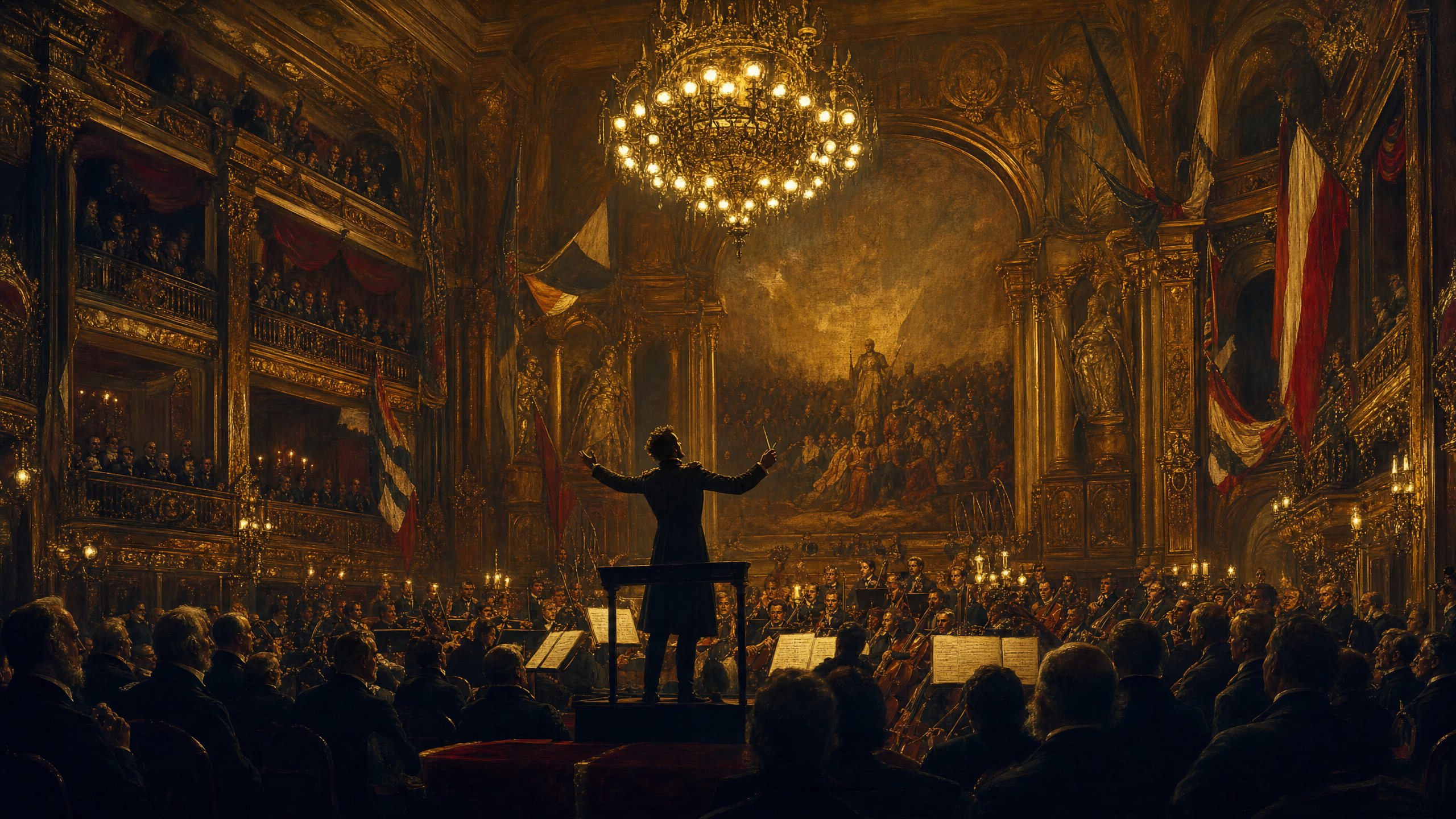
Mahler's Farewell: Music at the End of a World
Gustav Mahler's final completed symphony was his farewell to a world he sensed was ending. Written in the shadow of personal tragedy and historical foreboding, it would prove prophetic.
Historical Context
The twilight of the Austro-Hungarian Empire and the personal tragedies of Mahler's final years (1907–1911).
The Story
In 1907, Mahler suffered three devastating blows: the death of his eldest daughter from scarlet fever, the diagnosis of his own fatal heart condition, and his forced resignation from the Vienna Court Opera. His final completed symphony, the Ninth, composed in 1909–1910, is widely understood as a farewell to life itself. Its final movement, marked 'Adagio,' slowly dissolves into silence in one of the most moving endings in all of music. Mahler died in 1911, and within three years the Austro-Hungarian Empire he had served was plunged into the catastrophe of the First World War.
Deep Dive Essay
The full historical picture
Mahler's Farewell: Music at the End of a World
The year 1910. The air in Vienna, the glittering capital of the Austro-Hungarian Empire, was thick with a peculiar blend of fin-de-siècle decadence and an unsettling premonition. Below the surface of waltzes and coffee house debates, the foundations of a centuries-old order were crumbling. Emperor Franz Joseph I, a figure from another age, still reigned, but his vast, multi-ethnic empire was a powder keg of simmering nationalisms. Serbs, Croats, Czechs, Poles, and Hungarians chafed under Habsburg rule, their aspirations for self-determination growing louder. Artists and intellectuals, from Sigmund Freud to Gustav Klimt, were dissecting the human psyche and challenging conventional forms, sensing a profound shift in the very fabric of existence. It was a time of both dazzling innovation and profound anxiety, a world teetering on the brink of an abyss it could not yet fully comprehend. The grand, romantic narratives of the 19th century were giving way to something far more fragmented, more uncertain.
Into this turbulent crucible stepped Gustav Mahler, a titan of the late Romantic era. By 1907, Mahler was a man profoundly marked by tragedy. His reign as director of the Vienna Court Opera, a position of immense power and prestige, had ended in bitter resignation, fueled by antisemitic attacks and professional jealousies. Then, a crushing personal blow: his beloved eldest daughter, Maria Anna, succumbed to scarlet fever at the age of four. Shortly after, a devastating diagnosis: a congenital heart defect, a death sentence delivered with chilling certainty. These three blows – professional humiliation, the death of a child, and his own mortality staring him in the face – left Mahler a man adrift, grappling with the ultimate questions of life and death.
It was from this crucible of despair and introspection that Mahler’s Symphony No. 9 emerged, composed between 1909 and 1910. Though he never spoke of it explicitly as a farewell, the music itself speaks volumes. It is a work of immense scale and emotional depth, a journey through defiance, longing, and ultimately, acceptance. The symphony opens with a sense of struggle, a powerful, almost defiant wrestling with fate. Yet, it is the final movement, marked "Adagio," that truly defines the work. Here, Mahler strips away all pretense, offering a profound meditation on letting go. The music slowly, tenderly, unwinds, its soaring melodies gradually dissolving into quiet introspection. It is not a sudden, dramatic end, but a slow, almost imperceptible fading, like a breath held and then gently released, leaving behind an exquisite, aching silence.
Mahler died in 1911, never hearing his Ninth Symphony performed. Within three years, the fragile peace of Europe shattered. The assassination of Archduke Franz Ferdinand in Sarajevo ignited the First World War, and the Austro-Hungarian Empire, the very world Mahler had inhabited and wrestled with, disintegrated. Mahler's Ninth Symphony, therefore, stands as more than just a personal testament. It is a sonic prophecy, a profound artistic response to the twilight of an era. It captures the beauty, the complexity, and the ultimate fragility of a world on the cusp of radical change. For us, a century later, it remains a powerful reminder that even in the face of overwhelming loss and uncertainty, art can offer a path to understanding, to acceptance, and to a profound, moving farewell.
The Piece
Symphony No. 9
Gustav Mahler
Continue exploring
Back to Late Romantic & Nationalist