Historical Context
The world that shaped this fashion
The Revolutionary & Romantic Fashion era (1790-1860) was profoundly shaped by seismic political and social transformations. The French Revolution (1789-1799) dramatically dismantled the opulent ancien régime, leading to a rejection of aristocratic excess in dress. This manifested in simpler, less restrictive styles, particularly the chemise gown, which symbolized republican ideals and classical antiquity [1]. Napoleon Bonaparte's rise to power and the establishment of the First French Empire (1804-1815) solidified the Empire style, though he also sought to revive the French silk industry, leading to a brief return of more formal attire [2]. Concurrently, the Industrial Revolution began to revolutionize textile production, making fabrics more accessible and diverse, laying the groundwork for mass production and the eventual rise of ready-to-wear clothing [3]. The Romantic movement, emphasizing emotion, individualism, and a fascination with nature and the past, influenced fashion from the 1820s onwards, leading to a return of more elaborate silhouettes and decorative elements, contrasting with the earlier revolutionary simplicity. The early reign of Queen Victoria (1837-1860) further cemented a sense of moral conservatism and domesticity, which was reflected in increasingly modest and voluminous women's wear, notably the crinoline [4].
Fashion Character
Fashion during this period underwent a radical transformation, moving from the austere simplicity of the Revolutionary years to the elaborate romanticism of the mid-19th century. The early phase was dominated by the **Empire silhouette**, characterized by a high waistline just below the bust, a columnar, flowing skirt, and lightweight, often white, fabrics like muslin and cotton [2]. This neoclassical style, inspired by Greco-Roman antiquity, emphasized a natural, uncorseted form, symbolizing liberation and egalitarianism. Colors were initially subdued, favoring whites and pastels. As the Romantic era progressed (1820s-1840s), silhouettes became more exaggerated; sleeves puffed dramatically, waistlines returned to their natural position and were tightly cinched, and skirts widened, often supported by multiple petticoats. Fabrics became richer, including silks, satins, and velvets, with more vibrant colors and intricate embellishments like embroidery and lace. By the 1850s, the **crinoline** emerged, expanding skirts to unprecedented volumes, signifying status and feminine ideal, though often restricting movement. Menswear, influenced by figures like Beau Brummell, shifted towards tailored, darker suits, emphasizing understated elegance and meticulous grooming, a departure from the colorful extravagance of the previous century [5].
Key Figures
The designers who defined the age
Fashion meets history
Stories behind the garments
The Chemise Gown: A Symbol of Revolution
Imagine a world where fashion was a political statement, where shedding layers of restrictive clothing meant embracing liberty. The chemise gown was more than just a dress; it was a radical declaration.
Beau Brummell: The Architect of Modern Menswear
Before him, men's fashion was a riot of color and lace. After him, it became a canvas for quiet power and meticulous detail. Discover the man who invented the modern suit.
Queen Victoria's White Wedding: A Global Tradition Begins
Before 1840, brides wore any color. Then, a young queen walked down the aisle in a gown that changed weddings forever. Uncover the story behind the most iconic bridal tradition.
Curated style journey
Where to start looking
The Empire Waist Dress
Joséphine Bonaparte and anonymous dressmakers
This silhouette represents the radical break from past fashion, embodying revolutionary ideals and classical influences.
What to look for
Notice the high waistline, flowing skirt, lightweight fabrics like muslin, and minimal ornamentation, often paired with a simple shawl or spencer jacket. Observe how it emphasizes a natural, uncorseted form.
The Dandy's Tailored Ensemble
Beau Brummell
Explore how men's fashion shifted from flamboyant to understated elegance, laying the groundwork for modern menswear.
What to look for
Focus on the impeccable tailoring of the dark coat, the crisp white linen shirt, and the meticulously tied cravat. Note the absence of excessive ornamentation, emphasizing fit and quality over flashiness.
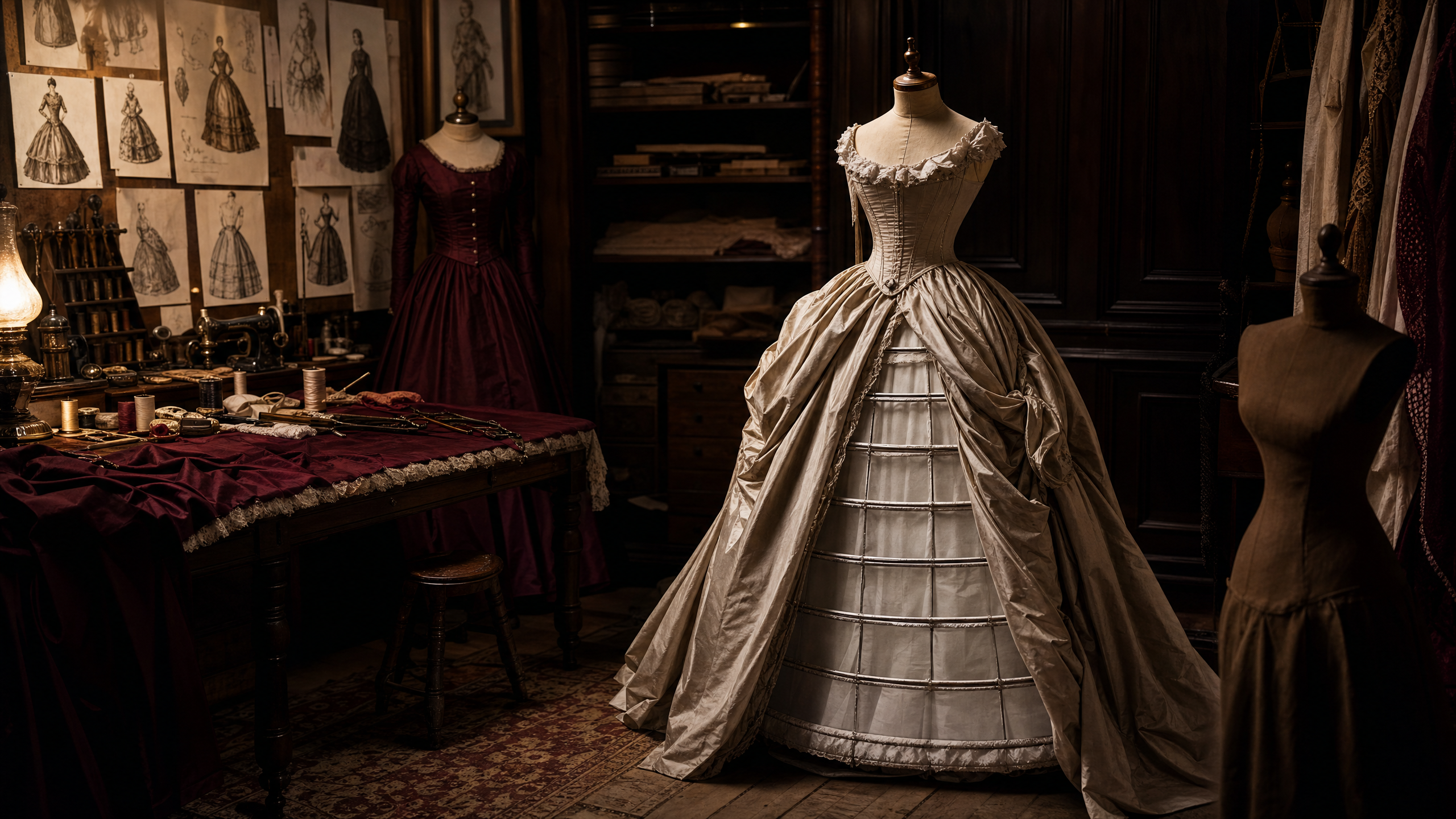
The Crinoline and Voluminous Skirts
Anonymous designers, Charles Frederick Worth (early influence)
Witness the return to exaggerated feminine silhouettes, driven by romantic ideals and industrial advancements in textile production.
What to look for
Observe the dramatic increase in skirt volume, initially achieved with multiple petticoats and later with the cage crinoline. Note the tight corseted waist, wide shoulders, and rich fabrics, reflecting a more conservative and opulent aesthetic.
AI-powered